3.5.0.0 Glucose Meter Accuracy
Recommendation
Recommendation
7.9 Health care providers should be aware of the medications and other factors that can interfere with glucose meter accuracy and choose appropriate devices for their patients based on these factors. E
Glucose meters meeting U.S. Food and Drug Administration (FDA) guidance for meter accuracy provide the most reliable data for diabetes management. There are several current standards for accuracy of blood glucose monitors, but the two most used are those of the International Organization for Standardization (ISO 15197:2013) and the FDA. The current ISO and FDA standards are compared in Table 7.1. In Europe, currently marketed monitors must meet current ISO standards. In the U.S., currently marketed monitors must meet the standard under which they were approved, which may not be the current standard. Moreover, the monitoring of current accuracy is left to the manufacturer and not routinely checked by an independent source.
Patients assume their glucose monitor is accurate because it is FDA cleared, but often that is not the case. There is substantial variation in the accuracy of widely used blood glucose monitoring systems. The Diabetes Technology Society Blood Glucose Monitoring System Surveillance Program provides information on the performance of devices used for SMBG (https://www.diabetestechnology.org/surveillance.shtml). In a recent analysis, the program found that only 6 of the top 18 glucose meters met the accuracy standard (57).
Factors Limiting Accuracy
Counterfeit Strips. Patients should be advised against purchasing or reselling preowned or second-hand test strips, as these may give incorrect results. Only unopened vials of glucose test strips should be used to ensure SMBG accuracy.
Oxygen. Currently available glucose monitors utilize an enzymatic reaction linked to an electrochemical reaction, either glucose oxidase or glucose dehydrogenase (58). Glucose oxidase monitors are sensitive to the oxygen available and should only be used with capillary blood in patients with normal oxygen saturation. Higher oxygen tensions (i.e., arterial blood or oxygen therapy) may result in false low-glucose readings, and low oxygen tensions (i.e., high altitude, hypoxia, or venous blood readings) may lead to false high-glucose readings. Glucose dehydrogenase monitors are not sensitive to oxygen.
Temperature. Because the reaction is sensitive to temperature, all monitors have an acceptable temperature range (58). Most will show an error if the temperature is unacceptable, but a few will provide a reading and a message indicating that the value may be incorrect.
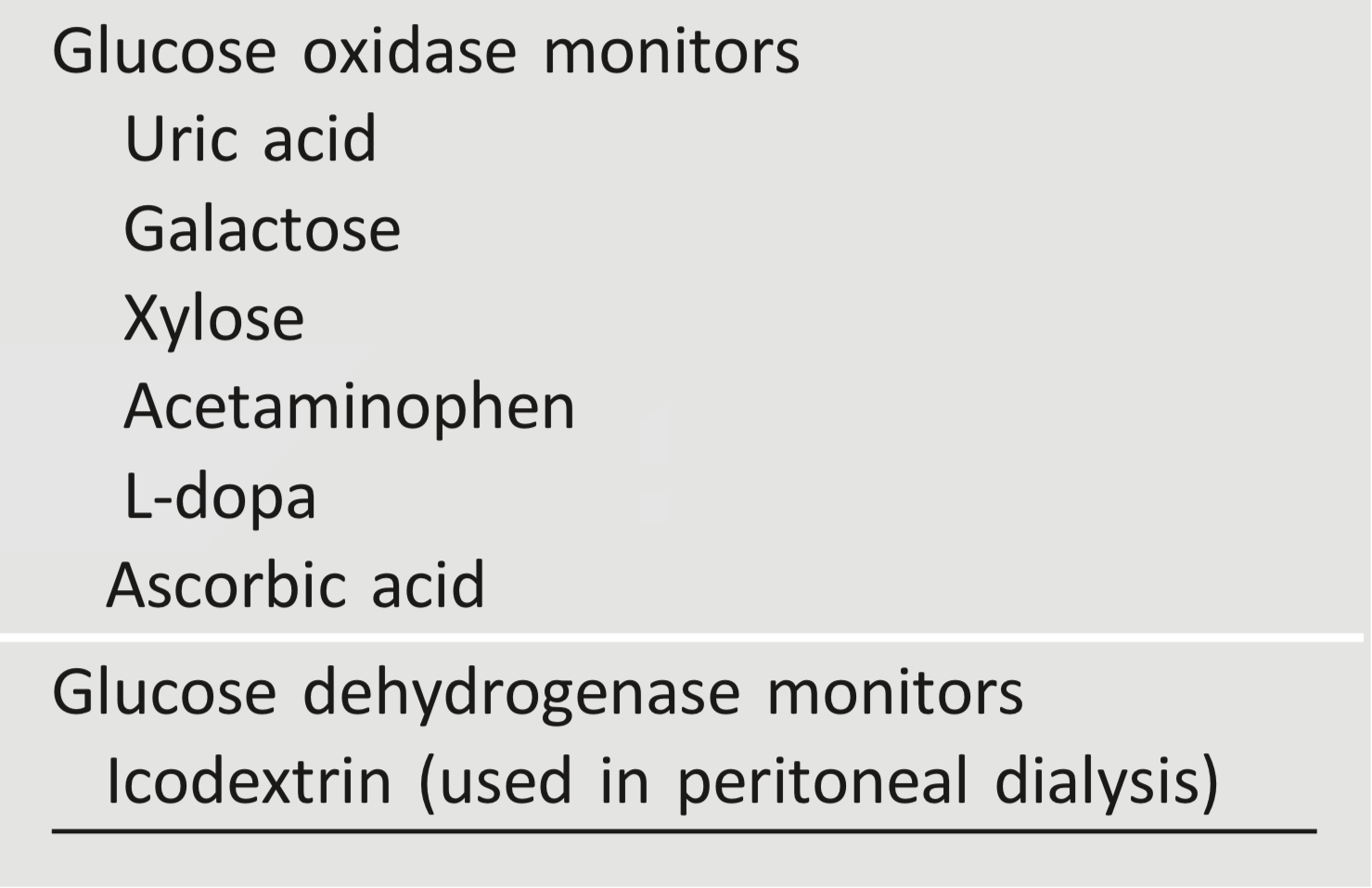
Interfering Substances. There are a few physiologic and pharmacologic factors that interfere with glucose readings. Most interfere only with glucose oxidase systems (58). They are listed in Table 7.2.
Table 7.1—Comparison of ISO 15197 and FDA blood glucose meter accuracy standards
BG, blood glucose. To convert mg/dL to mmol/L, see http://www.endmemo.com/medical/unitconvert/Glucose.php.
†The range ofBGvalues for which the meter has been proven accurate and will provide readings (other than low, high, or error).
‡Values outside of the “clinically acceptable” A and B regions are considered “outlier” readings and may be dangerous to use for therapeutic decisions128.
Table 7.2—Interfering substances