xxxxx

1.0.0.0 In­tro­duc­tion

The Amer­i­can Di­a­betes As­so­ci­a­tion (ADA) “Stan­dards of Med­i­cal Care in Di­a­betes” in­cludes ADA’s cur­rent clin­i­cal prac­tice rec­om­men­da­tions and is in­tend­ed to pro­vide the com­po­nents of di­a­betes care, gen­er­al treat­ment goals and guide­lines, and tools to eval­u­ate qual­i­ty of care. Mem­bers of the ADA Pro­fes­sion­al Prac­tice Com­mit­tee, a mul­ti­dis­ci­plinary ex­pert com­mit­tee, are re­spon­si­ble for up­dat­ing the Stan­dards of Care an­nu­al­ly, or more fre­quent­ly as war­rant­ed. For a de­tailed de­scrip­tion of ADA stan­dards, state­ments, and re­ports, as well as the ev­i­dence-‍grad­ing sys­tem for ADA’s clin­i­cal prac­tice rec­om­men­da­tions, please refer to the Stan­dards of Care In­tro­duc­tion. Read­ers who wish to com­ment on the Stan­dards of Care are in­vit­ed to do so at pro­fes­sion­al.di­a­betes.org/‍SOC.

There is strong and con­sis­tent ev­i­dence that obe­si­ty man­age­ment can delay the pro­gres­sion from predi­a­betes to type 2 di­a­betes (1-5,) and is beneficial in the treat­ment of type 2 di­a­betes (6-17,). In pa­tients with type 2 di­a­betes who are over­weight or obese, mod­est and sus­tained weight loss has been shown to im­prove glycemic con­trol and to re­duce the need for glu­cose-‍low­er­ing med­i­ca­tions (6-8,). Small stud­ies have demon­strat­ed that in pa­tients with type 2 di­a­betes and obe­si­ty, more ex­treme di­etary en­er­gy re­stric­tion with very low-‍calo­rie diets can re­duce A1C to <6.5% (48 mmol/‍mol) and fast­ing glu­cose to <126 mg/dL (7.0 mmol/‍L) in the ab­sence of phar­ma­co­log­ic ther­a­py or on­go­ing pro­ce­dures (10,18,19). Weight loss– in­duced im­provements in glycemia are most like­ly to occur early in the nat­u­ral his­to­ry of type 2 di­a­betes when obe­si­ty-‍as­so­ci­at­ed in­sulin re­sis­tance has caused re­versible β-cell dys­func­tion but in­sulin se­cre­to­ry ca­pac­i­ty re­mains rel­a­tive­ly pre­served (8,11,19,20). The goal of this sec­tion is to pro­vide ev­i­dence-‍based rec­om­men­da­tions for weight-‍loss ther­a­py, in­clud­ing diet, be­hav­ioral, phar­ma­co­log­ic, and sur­gi­cal in­ter­ven­tions, for obe­si­ty man­age­ment as treat­ment for hy­per­glycemia in type 2 di­a­betes.

Sug­gest­ed ci­ta­tion: Amer­i­can Di­a­betes As­so­ci­a­tion. 8. Obe­si­ty man­age­ment for the treat­ment of type 2 di­a­betes: Stan­dards of Med­i­cal Care in Di­a­betesd2019. Di­a­betes Care 2019;42(Suppl. 1): S81–S89
© 2018 by the Amer­i­can Di­a­betes As­so­ci­a­tion. Read­ers may use this ar­ti­cle as long as the work is prop­er­ly cited, the use is ed­u­ca­tion­al and not for prof­it, and the work is not al­tered. More in­for­ma­tion is avail­able at http://www.di­a­betesjournals .org/‍con­tent/‍license.

xxxxx

2.0.0.0 AS­SESS­MENT

Rec­om­men­da­tion

8.1 At each pa­tient en­counter, BMI should be cal­cu­lat­ed and doc­u­ment­ed in the med­i­cal record. B

At each rou­tine pa­tient en­counter, BMI should be cal­cu­lat­ed as weight di­vid­ed by height squared (kg/m2) (21). BMI should be clas­sified to de­ter­mine the pres­ence of over­weight or obe­si­ty, dis­cussed with the pa­tient, and doc­u­ment­ed in the pa­tient record. In Asian Amer­i­cans, the BMI cut­off points to define over­weight and obe­si­ty are lower than in other pop­u­la­tions (Table 8.1) (22,23). Providers should ad­vise pa­tients who are over­weight or obese that, in gen­er­al, high­er BMIs in­crease the risk of car­dio­vas­cu­lar dis­ease and all-‍cause mor­tal­i­ty. Providers should as­sess each pa­tient’s readi­ness to achieve weight loss and joint­ly de­ter­mine weight-‍loss goals and in­ter­ven­tion strate­gies. Strate­gies may in­clude diet, phys­i­cal ac­tiv­i­ty, be­hav­ioral ther­a­py, phar­ma­co­log­ic ther­a­py, and metabol­ic surgery (Table 8.1). The lat­ter two strate­gies may be pre­scribed for care­ful­ly se­lect­ed pa­tients as ad­juncts to diet, phys­i­cal ac­tiv­i­ty, and be­hav­ioral ther­a­py.

Table 8.1—Treat­ment op­tions for over­weight and obe­si­ty in type 2 di­a­betes

xxxxx

3.0.0.0 DIET, PHYS­I­CAL AC­TIV­I­TY, AND BE­HAV­IORAL THER­A­PY

3.1.0.0 Rec­om­men­da­tions

Rec­om­men­da­tions

8.2 Diet, phys­i­cal ac­tiv­i­ty, and be­hav­ioral ther­a­py de­signed to achieve and main­tain >5% weight loss should be pre­scribed for pa­tients with type 2 di­a­betes who are over­weight or obese and ready to achieve weight loss. A

8.3 Such in­ter­ven­tions should be high in­ten­si­ty (≥16 ses­sions in 6 months) and focus on diet, phys­i­cal ac­tiv­i­ty, and be­hav­ioral strate­gies to achieve a 500–750 kcal/‍day en­er­gy deficit. A

8.4 Diets should be in­di­vid­u­al­ized, as those that pro­vide the same caloric re­stric­tion but dif­fer in pro­tein, car­bo­hy­drate, and fat con­tent are equal­ly ef­fec­tive in achiev­ing weight loss. A

8.5 For pa­tients who achieve short-‍term weight-‍loss goals, long-‍term (≥1 year) com­pre­hen­sive weight-‍main­te­nance pro­grams should be pre­scribed. Such pro­grams should pro­vide at least month­ly con­tact and en­cour­age on­go­ing mon­i­tor­ing of body weight (week­ly or more fre­quent­ly) and/‍or other self-‍mon­i­tor­ing strate­gies, such as track­ing in­take, steps, etc.; con­tin­ued con­sump­tion of a re­duced-calorie diet; and par­tic­i­pa­tion in high lev­els of phys­i­cal ac­tiv­i­ty (200– 300 min/‍week). A

8.6 To achieve weight loss of >5%, short-‍term (3-‍month) in­ter­ven­tions that use very low-‍calo­rie diets (#800 kcal/‍day) and total meal re­place­ments may be pre­scribed for care­ful­ly se­lect­ed pa­tients by trained prac­ti­tion­ers in med­i­cal care set­tings with close med­i­cal mon­i­tor­ing. To main­tain weight loss, such pro­grams must in­cor­po­rate long-‍term com­pre­hen­sive weight-‍main­te­nance coun­sel­ing. B

Among pa­tients with type 2 di­a­betes who are over­weight or obese and have in­ad­e­quate glycemic, blood pres­sure, and lipid con­trol and/‍or other obe­si­ty-‍re­lat­ed med­i­cal con­di­tions, lifestyle changes that re­sult in mod­est and sus­tained weight loss pro­duce clin­i­cally mean­ing­ful re­duc­tions in blood glu­cose, A1C, and triglyc­erides (6-8,). Greater weight loss pro­duces even greater benefits, in­clud­ing re­duc­tions in blood pres­sure, im­provements in LDL and HDL choles­terol, and re­duc­tions in the need for med­i­ca­tions to con­trol blood glu­cose, blood pres­sure, and lipids (6–8,24), and may re­sult in achieve­ment of glycemic goals in the ab­sence of antihy­per­glycemia agent use in some pa­tients (25).

xxxxx

3.2.0.0 Look AHEAD Trial

Al­though the Ac­tion for Health in Di­a­betes (Look AHEAD) trial did not show that an in­ten­sive lifestyle in­ter­ven­tion re­duced car­dio­vas­cu­lar events in adults with type 2 di­a­betes who were over­weight or obese (26), it did show the fea­si­bil­i­ty of achiev­ing and main­taining long-‍term weight loss in pa­tients with type 2 di­a­betes. In the Look AHEAD in­ten­sive lifestyle in­ter­ven­tion group, mean weight loss was 4.7% at 8 years (27). Ap­prox­i­mate­ly 50% of in­ten­sive lifestyle in­ter­ven­tion par­tic­i­pants lost and main­tained ≥5% and 27% lost and main­tained ≥10% of their ini­tial body weight at 8 years (27). Par­tic­i­pants ran­dom­ly as­signed to the in­ten­sive lifestyle group achieved equiv­a­lent risk fac­tor con­trol but re­quired fewer glu­cose-‍, blood pres­sure–, and lipid-‍low­er­ing med­i­ca­tions than those ran­dom­ly as­signed to stan­dard care. Sec­ondary anal­y­ses of the Look AHEAD trial and other large car­dio­vas­cu­lar out­come stud­ies doc­u­ment other benefits of weight loss in pa­tients with type 2 di­a­betes, in­clud­ing im­provements in mo­bil­i­ty, phys­i­cal and sex­u­al func­tion, and health-‍re­lat­ed qual­i­ty of life (28). A post hoc anal­y­sis of the Look AHEAD study sug­gests that het­ero­ge­neous treat­ment ef­fects may have been pre­sent. Par­tic­i­pants who had mod­er­ate­ly or poor­ly con­trolled di­a­betes (A1C ≥6.8% [51 mmol/‍mol]) as well as both those with well-‍con­trolled di­a­betes (A1C <6.8% [51 mmol/‍mol]) and good sel­f­re­port­ed health were found to have significant­ly re­duced car­dio­vas­cu­lar events with in­ten­sive lifestyle in­ter­ven­tion dur­ing fol­low-‍up (29).

xxxxx

3.3.0.0 Lifestyle In­ter­ven­tions

Significant weight loss can be at­tained with lifestyle pro­grams that achieve a 500–750 kcal/‍day en­er­gy deficit, which in most cases is ap­prox­i­mate­ly 1,200– 1,500 kcal/‍day for women and 1,500– 1,800 kcal/‍day for men, ad­just­ed for the in­di­vid­u­al’s base­line body weight. Weight loss of 3–5% is the min­i­mum nec­es­sary for any clin­i­cal benefit (21,30). How­ev­er, weight-‍loss benefits are pro­gres­sive; more in­ten­sive weight-‍loss goals (>5%, >7%, >15%, etc.) may be pur­sued if need­ed to achieve a healthy weight and if they can be fea­si­bly and safe­ly at­tained.

These diets may dif­fer in the types of foods they re­strict (such as high-‍fat or high-‍car­bo­hy­drate foods) but are ef­fec­tive if they cre­ate the nec­es­sary en­er­gy deficit (21,31–33). Use of meal re­place­ment plans pre­scribed by trained prac­ti­tion­ers, with close pa­tient mon­i­tor­ing, can be beneficial. With­in the in­ten­sive lifestyle in­ter­ven­tion group of the Look AHEAD trial, for ex­am­ple, use of a par­tial meal re­place­ment plan was as­so­ci­at­ed with im­provements in diet qual­i­ty (34). The diet choice should be based on the pa­tient’s health sta­tus and pref­er­ences.

In­ten­sive be­hav­ioral lifestyle in­ter­ven­tions should in­clude ≥16 ses­sions in 6 months and focus on diet, phys­i­cal ac­tiv­i­ty, and be­hav­ioral strate­gies to achieve an ˜500–750 kcal/‍day en­er­gy deficit. In­ter­ven­tions should be pro­vided by trained in­ter­ven­tionists in ei­ther in­di­vid­u­al or group ses­sions (30).

Pa­tients with type 2 di­a­betes who are over­weight or obese and have lost weight dur­ing the 6-‍month in­ten­sive be­hav­ioral lifestyle in­ter­ven­tion should be en­rolled in long-‍term (≥1 year) com­pre­hen­sive weight-‍loss main­te­nance pro­grams that pro­vide at least month­ly con­tact with a trained in­ter­ven­tionist and focus on on­go­ing mon­i­tor­ing of body weight (week­ly or more fre­quent­ly) and/‍or other self-‍mon­i­tor­ing strate­gies such as track­ing in­take, steps, etc.; con­tin­ued con­sump­tion of a re­duced-calorie diet; and par­tic­i­pa­tion in high lev­els of phys­i­cal ac­tiv­i­ty (200–300 min/ week (35). Some com­mer­cial and pro­pri­etary weight-‍loss pro­grams have shown promis­ing weight-‍loss re­sults (36).

When pro­vided by trained prac­ti­tion­ers in med­i­cal care set­tings with close med­i­cal mon­i­tor­ing, short-‍term (3-‍month) in­ter­ven­tions that use very low-‍calo­rie diets (defined as ≤800 kcal/‍day) and total meal re­place­ments may achieve greater short-‍term weight loss (10%–15%) than in­ten­sive be­hav­ioral lifestyle in­ter­ven­tions that typ­i­cal­ly achieve 5% weight loss. How­ev­er, weight re­gain fol­low­ing the ces­sa­tion of very low-‍calo­rie diets is greater than fol­low­ing in­ten­sive be­hav­ioral lifestyle in­ter­ven­tions un­less a long-‍term com­pre­hen­sive weight-‍loss main­te­nance pro­gram is pro­vided (37,38).

xxxxx

4.0.0.0 PHARMACOTHER­A­PY

4.1.0.0 Rec­om­men­da­tions

Rec­om­men­da­tions

8.7 When choos­ing glu­cose-‍low­er­ing med­i­ca­tions for over­weight or obese pa­tients with type 2 di­a­betes, con­sid­er their ef­fect on weight. E

8.8 When­ev­er pos­si­ble, min­i­mize med­i­ca­tions for co­mor­bid con­di­tions that are as­so­ci­at­ed with weight gain. E

8.9 Weight-‍loss med­i­ca­tions are ef­fec­tive as ad­juncts to diet, phys­i­cal ac­tiv­i­ty, and be­hav­ioral coun­sel­ing for se­lect­ed pa­tients with type 2 di­a­betes and BMI ≥27 kg/m2. Po­ten­tial benefits must be weighed against the po­ten­tial risks of the med­i­ca­tions. A

8.10 If a pa­tient’s re­sponse to weight-‍loss med­i­ca­tions is <5% weight loss after 3 months or if there are significant safe­ty or tol­er­a­bil­i­ty is­sues at any time, the med­i­ca­tion should be discon­tin­ued and al­ter­na­tive med­i­ca­tions or treat­ment ap­proach­es should be con­sid­ered. A

xxxxx

4.2.0.0 Antihy­per­glycemia Ther­a­py

Agents as­so­ci­at­ed with vary­ing de­grees of weight loss in­clude met­formin, α-‍glu­cosi­dase in­hibitors, sodi­um–glu­cose co­trans­porter 2 in­hibitors, glucagon-‍like pep­tide 1 re­cep­tor ag­o­nists, and amylin mimet­ics. Dipep­tidyl pep­ti­dase 4 in­hibitors are weight neu­tral. Un­like these agents, in­sulin sec­re­t­a­gogues, thi­a­zo­lidine­diones, and in­sulin often cause weight gain (see Sec­tion 9 “Phar­ma­colo­gic Ap­proach­es to Glycemic Treat­ment”).

A re­cent meta-‍anal­y­sis of 227 ran­dom­ized con­trolled tri­als of antihy­per­glycemia treat­ments in type 2 di­a­betes found that A1C changes were not as­so­ci­at­ed with base­line BMI, in­di­cat­ing that pa­tients with obe­si­ty can benefit from the same types of treat­ments for di­a­betes as nor­mal-‍weight pa­tients (39).

xxxxx

4.3.0.0 Con­comi­tant Med­i­ca­tions

Providers should care­ful­ly re­view the pa­tient’s con­comi­tant med­i­ca­tions and, when­ev­er pos­si­ble, min­i­mize or pro­vide al­ter­na­tives for med­i­ca­tions that pro­mote weight gain. Med­i­ca­tions as­so­ci­at­ed with weight gain in­clude an­tipsy­chotics (e.g., cloza­p­ine, olan­za­p­ine, risperi­done, etc.) and an­tide­pres­sants (e.g., tri­cyclic an­tide­pres­sants, se­lec­tive sero­tonin re­up­take in­hibitors, and monoamine ox­i­dase in­hibitors), glu­co­cor­ti­coids, in­jectable pro­gestins, an­ti­con­vul­sants in­clud­ing gabapentin, and pos­si­bly se­dat­ing an­ti­his­tamines and an­ti­cholin­er­gics (40).

xxxxx

4.4.0.0 Ap­proved Weight-‍Loss Med­i­ca­tions

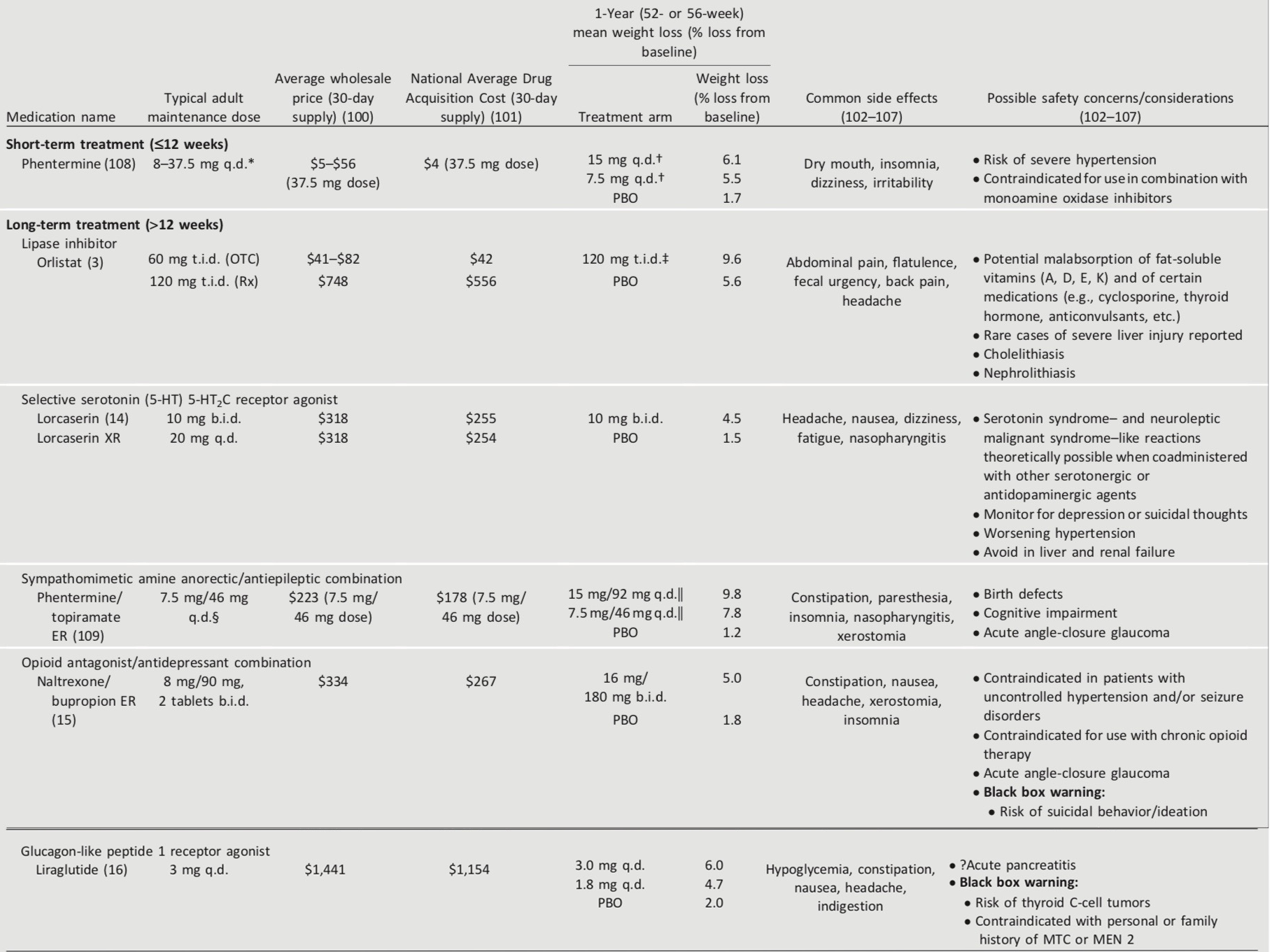
The U.S. Food and Drug Ad­min­is­tra­tion (FDA) has ap­proved med­i­ca­tions for both short-‍term and long-‍term weight man­age­ment as ad­juncts to diet, ex­er­cise, and be­hav­ioral ther­a­py. Near­ly all FDA- ap­proved med­i­ca­tions for weight loss have been shown to im­prove glycemic con­trol in pa­tients with type 2 di­a­betes and delay pro­gres­sion to type 2 di­a­betes in pa­tients at risk (41). Phen­ter­mine is in­di­cat­ed as short-‍term (≤12 weeks) treat­ment (42). Five weight-‍loss med­i­ca­tions (or com­bi­na­tion med­i­ca­tions) are FDA-‍ap­proved for long-‍term use (more than a few weeks) by pa­tients with BMI ≥27 kg/m2 with one or more obe­si­ty-‍as­so­ci­at­ed co­mor­bid con­di­tions (e.g., type 2 di­a­betes, hy­per­ten­sion, and dys­lipi­demia) who are mo­ti­vat­ed to lose weight (41). Med­i­ca­tions ap­proved by the FDA for the treat­ment of obe­si­ty and their ad­van­tages and disad­van­tages are sum­ma­rized in Table 8.2. The ra­tio­nale for weight-‍loss med­i­ca­tions is to help pa­tients to more con­sis­tently ad­here to low-‍calo­rie diets and to rein­force lifestyle changes. Providers should be knowl­edge­able about the prod­uct label and should bal­ance the po­ten­tial benefits of suc­cess­ful weight loss against the po­ten­tial risks of the med­i­ca­tion for each pa­tient. These med­i­ca­tions are contrain­di­cat­ed in women who are preg­nant or ac­tive­ly try­ing to con­ceive. Women of reprod­uctive po­ten­tial must be coun­seled re­gard­ing the use of re­li­able meth­ods of con­tra­cep­tion.

Table 8.2—Med­i­ca­tions ap­proved by the FDA for the treat­ment of obe­si­ty

-‍-‍-‍-‍To be in­sert­ed-‍-‍-‍

xxxxx

4.5.0.0 As­sess­ing Efficacy and Safe­ty

Efficacy and safe­ty should be as­sessed at least month­ly for the first 3 months of treat­ment. If a pa­tient’s re­sponse is deemed insufficient (weight loss <5%) after 3 months or if there are significant safe­ty or tol­er­a­bil­i­ty is­sues at any time, the med­i­ca­tion should be discon­tin­ued and al­ter­na­tive med­i­ca­tions or treat­ment ap­proach­es should be con­sid­ered.

xxxxx

5.0.0.0 MED­I­CAL DE­VICES FOR WEIGHT LOSS

Sev­er­al min­i­mal­ly in­va­sive med­i­cal de­vices have been re­cently ap­proved by the FDA for short-‍term weight loss (43). It re­mains to be seen how these are used for obe­si­ty treat­ment. Given the high cost, ex­tremely lim­it­ed in­sur­ance cov­er­age, and pauci­ty of data in peo­ple with di­a­betes at this time, these are not con­sid­ered to be the stan­dard of care for obe­si­ty man­age­ment in peo­ple with type 2 di­a­betes.

xxxxx

6.0.0.0 METABOL­IC SURGERY

6.1.0.0 Rec­om­men­da­tions

Rec­om­men­da­tions

8.11 Metabol­ic surgery should be rec­om­mend­ed as an op­tion to treat type 2 di­a­betes in ap­pro­pri­ate sur­gi­cal can­di­dates with BMI ≥40 kg/m2 (BMI ≥37.5 kg/m2 in Asian Amer­i­cans) and in adults with BMI 35.0–39.9 kg/m2 (32.5–37.4 kg/m2 in Asian Amer­i­cans) who do not achieve durable weight loss and im­provement in co­mor­bidities (in­clud­ing hy­per­glycemia) with rea­son­able nonsur­gi­cal meth­ods. A

8.12 Metabol­ic surgery may be con­sid­ered as an op­tion for adults with type 2 di­a­betes and BMI 30.0– 34.9 kg/m2 (27.5–32.4 kg/m2 in Asian Amer­i­cans) who do not achieve durable weight loss and im­provement in co­mor­bidities (in­clud­ing hy­per­glycemia) with rea­son­able nonsur­gi­cal meth­ods. A

8.13 Metabol­ic surgery should be per­formed in high-‍vol­ume cen­ters with mul­ti­dis­ci­plinary teams that un­der­stand and are ex­pe­ri­enced in the man­age­ment of di­a­betes and gas­troin­testi­nal surgery. C

8.14 Long-‍term lifestyle sup­port and rou­tine mon­i­tor­ing of mi­cronu­tri­ent and nu­tri­tion­al sta­tus must be pro­vided to pa­tients after surgery, ac­cord­ing to guide­lines for post­op­er­a­tive man­age­ment of metabol­ic surgery by na­tion­al and interna­tion­al pro­fes­sion­al so­ci­eties. C

8.15 Peo­ple pre­senting for metabol­ic surgery should re­ceive a com­pre­hen­sive readi­ness and men­tal health as­sessment. B

8.16 Peo­ple who un­der­go metabol­ic surgery should be eval­u­ated to as­sess the need for on­go­ing men­tal health ser­vices to help them ad­just to med­i­cal and psy­choso­cial changes after surgery. C

Sev­er­al gas­troin­testi­nal (GI) op­er­a­tions in­clud­ing par­tial gas­trec­tomies and bariatric pro­ce­dures (35) pro­mote dra­mat­ic and durable weight loss and im­provement of type 2 di­a­betes in many pa­tients. Given the mag­ni­tude and ra­pid­i­ty of the ef­fect of GI surgery on hy­per­glycemia and experimen­tal ev­i­dence that re­ar­range­ments of GI anato­my sim­i­lar to those in some metabol­ic pro­ce­dures di­rect­ly af­fect glu­cose home­osta­sis (36), GI in­ter­ven­tions have been sug­gest­ed as treat­ments for type 2 di­a­betes, and in that con­text they are termed “metabol­ic surgery.”

A sub­stan­tial body of ev­i­dence has now been ac­cu­mu­lat­ed, in­clud­ing data from nu­mer­ous ran­dom­ized con­trolled (non­blind­ed) clin­i­cal tri­als, demon­strat­ing that metabol­ic surgery achieves su­pe­ri­or glycemic con­trol and re­duc­tion of car­dio­vas­cu­lar risk fac­tors in pa­tients with type 2 di­a­betes and obe­si­ty com­pared with var­i­ous lifestyle/med­i­cal in­ter­ven­tions (17). Im­prove­ments in mi­crovas­cu­lar com­pli­ca­tions of di­a­betes, car­dio­vas­cu­lar dis­ease, and can­cer have been ob­served only in nonran­dom­ized ob­ser­va­tion­al stud­ies (44-53,). Co­hort stud­ies at­tempt­ing to match sur­gi­cal and nonsur­gi­cal sub­jects sug­gest that the pro­ce­dure may re­duce longer-‍term mor­tal­i­ty (45).

On the basis of this mount­ing ev­i­dence, sev­er­al or­ga­ni­za­tions and gov­ern­ment agen­cies have rec­om­mend­ed ex­pan­ding the in­di­ca­tions for metabol­ic surgery to in­clude pa­tients with type 2 di­a­betes who do not achieve durable weight loss and im­provement in co­mor­bidities (in­clud­ing hy­per­glycemia) with rea­son­able nonsur­gi­cal meth­ods at BMIs as low as 30 kg/m2 (27.5 kg/m2 for Asian Amer­i­cans) (54-61,). Please refer to “Metabol­ic Surgery in the Treat­ment Al­go­rithm for Type 2 Di­a­betes: A Joint State­ment by In­terna­tion­al Di­a­betes Or­ga­ni­za­tions” for a thor­ough re­view (17).

Ran­dom­ized con­trolled tri­als have doc­u­ment­ed di­a­betes re­mis­sion dur­ing post­op­er­a­tive fol­low-‍up rang­ing from 1 to 5 years in 30%–63% of pa­tients with Roux-‍en-‍Y gas­tric by­pass (RYGB), which gen­er­ally leads to greater de­grees and lengths of re­mis­sion com­pared with other bariatric surg­eries (17,62). Avail­able data sug­gest an ero­sion of di­a­betes re­mis­sion over time (63): 35%–50% or more of pa­tients who ini­tially achieve re­mis­sion of di­a­betes even­tu­al­ly ex­pe­ri­ence re­cur­rence. How­ev­er, the me­di­an dis­ease-‍free pe­ri­od among such in­di­vid­u­als fol­low­ing RYGB is 8.3 years (64,65). With or with­out di­a­betes re­lapse, the ma­jor­i­ty of pa­tients who un­der­go surgery main­tain sub­stan­tial im­provement of glycemic con­trol from base­line for at least 5 (66,67) to 15 (45,46,65,68–70) years.

Ex­ceed­ing­ly few presur­gi­cal pre­dic­tors of suc­cess have been iden­tified, but younger age, short­er du­ra­tion of di­a­betes (e.g., <8 years) (71), nonuse of in­sulin, main­te­nance of weight loss, and bet­ter glycemic con­trol are con­sis­tently as­so­ci­at­ed with high­er rates of di­a­betes re­mis­sion and/‍or lower risk of weight re­gain (45,69,71,72). Greater base­line vis­cer­al fat area may also help to pre­dict bet­ter post­op­er­a­tive out­comes, es­pe­cial­ly among Asian Amer­i­can pa­tients with type 2 di­a­betes, who typ­i­cal­ly have more vis­cer­al fat com­pared with Cau­casians with di­a­betes of the same BMI (73).

Be­yond im­prov­ing glycemia, metabol­ic surgery has been shown to con­fer ad­di­tion­al health benefits in ran­dom­ized con­trolled tri­als, in­clud­ing sub­stan­tial re­duc­tions in car­dio­vas­cu­lar dis­ease risk fac­tors (17), re­duc­tions in in­ci­dence of mi­crovas­cu­lar dis­ease (74), and en­hance­ments in qual­i­ty of life (66,71,75).

Al­though metabol­ic surgery has been shown to im­prove the metabol­ic profiles of pa­tients with type 1 di­a­betes and mor­bid obe­si­ty, es­tab­lish­ing the role of metabol­ic surgery in such pa­tients will re­quire larg­er and longer stud­ies (76).

Metabol­ic surgery is more ex­pen­sive than nonsur­gi­cal man­age­ment strate­gies, but ret­ro­spec­tive anal­y­ses and mod­el­ing stud­ies sug­gest that metabol­ic surgery may be cost-‍ef­fec­tive or even cost-‍sav­ing for pa­tients with type 2 di­a­betes. How­ev­er, re­sults are large­ly de­pen­dent on as­sump­tions about the long-‍term ef­fec­tiveness and safe­ty of the pro­ce­dures (77,78).

xxxxx

6.2.0.0 Ad­verse Ef­fects

The safe­ty of metabol­ic surgery has im­proved significant­ly over the past two decades, with con­tin­ued refine­ment of min­i­mal­ly in­va­sive ap­proach­es (la­paro­scop­ic surgery), en­hanced train­ing and cre­den­tial­ing, and in­volve­ment of mul­ti­dis­ci­plinary teams. Mor­tal­i­ty rates with metabol­ic op­er­a­tions are typ­i­cal­ly 0.1%–0.5%, sim­i­lar to chole­cys­tec­to­my or hys­terec­to­my (79-83,). Mor­bid­i­ty has also dra­mat­ically de­clined with la­paro­scop­ic ap­proach­es. Major com­pli­ca­tions rates (e.g., ve­nous throm­boem­bolism, need for op­er­a­tive rein­ter­ven­tion) are 2%–6%, with other minor com­pli­ca­tions in up to 15% (79-88,), which com­pare fa­vor­ably with rates for other com­mon­ly per­formed elec­tive op­er­a­tions (83). Em­pir­i­cal data sug­gest that proficien­cy of the op­er­at­ing sur­geon is an im­por­tant fac­tor for de­ter­min­ing mor­tal­i­ty, com­pli­ca­tions, reop­er­a­tions, and read­mis­sions (89).

Longer-‍term con­cerns in­clude dump­ing syn­drome (nau­sea, colic, and di­ar­rhea), vi­ta­min and min­er­al deficien­cies, ane­mia, os­teo­poro­sis, and, rarely (90), se­vere hy­po­glycemia. Long-‍term nu­tri­tion­al and mi­cronu­tri­ent deficien­cies and re­lat­ed com­pli­ca­tions occur with vari­able fre­quen­cy de­pend­ing on the type of pro­ce­dure and re­quire life-‍long vi­ta­min/nu­tri­tion­al sup­ple­men­ta­tion (91,92). Post­pran­di­al hy­po­glycemia is most like­ly to occur with RYGB (92,93). The exact preva­lence of symp­tomat­ic hy­po­glycemia is un­known. In one study, it af­fected 11% of 450 pa­tients who had un­der­gone RYGB or ver­ti­cal sleeve gas­trec­to­my (90). Pa­tients who un­der­go metabol­ic surgery may be at in­creased risk for sub­stance use, in­clud­ing drug and al­co­hol use and cigarette smok­ing. Ad­di­tion­al po­ten­tial risks of metabol­ic surgery that have been de­scribed in­clude wors­en­ing or new-‍onset de­pres­sion and/‍or anx­i­ety, need for ad­di­tion­al GI surgery, and sui­ci­dal ideation (94-97,).

Peo­ple with di­a­betes pre­senting for metabol­ic surgery also have in­creased rates of de­pres­sion and other major psy­chi­atric dis­or­ders (98). Can­di­dates for metabol­ic surgery with his­to­ries of al­co­hol, to­bac­co, or sub­stance abuse; significant de­pres­sion; sui­ci­dal ideation; or other men­tal health con­di­tions should there­fore first be as­sessed by a men­tal health pro­fes­sion­al with ex­pertise in obe­si­ty man­age­ment prior to con­sid­eration for surgery (99). Surgery should be post­poned in pa­tients with al­co­hol or sub­stance abuse dis­or­ders, significant de­pres­sion, sui­ci­dal ideation, or other men­tal health con­di­tions until these con­di­tions have been fully ad­dressed. In­di­vid­u­als with preop­er­a­tive psy­chopathol­o­gy should be as­sessed reg­u­lar­ly fol­low­ing metabol­ic surgery to op­ti­mize men­tal health man­age­ment and to en­sure psy­chi­atric symp­toms do not in­ter­fere with weight loss and lifestyle changes.

xxxxx

7.0.0.0 Ref­er­ences

  1. Knowl­er WC, Bar­rett-‍Con­nor E, Fowler SE, et al.; Di­a­betes Pre­ven­tion Pro­gram Re­search Group. Re­duc­tion in the in­ci­dence of type 2 di­a­betes with lifestyle in­ter­ven­tion or met­formin. N Engl J Med 2002;346:393–403

  2. Gar­vey WT, Ryan DH, Henry R, et al. Pre­ven­tion of type 2 di­a­betes in sub­jects with predi­a­betes and metabol­ic syn­drome treat­ed with phen­ter­mine and top­i­ra­mate ex­tend­ed re­lease. Di­a­betes Care 2014;37:912–921

  3. Torg­er­son JS, Haupt­man J, Boldrin MN, Sjo¨stro¨m L. XENi­cal in the pre­ven­tion of Di­a­betes in Obese Sub­jects (XEN­DOS) study: a ran­dom­ized study of orli­s­tat as an ad­junct to lifestyle changes for the pre­ven­tion of type 2 di­a­betes in obese pa­tients. Di­a­betes Care 2004;27:155–161

  4. le Roux CW, As­trup A, Fu­jio­ka K, et al.; SCALE Obe­si­ty Predi­a­betes NN8022-1839 Study Group. 3 years of li­raglu­tide ver­sus place­bo for type 2 di­a­betes risk re­duc­tion and weight man­age­ment in in­di­vid­u­als with predi­a­betes: a ran­domised, dou­ble-‍blind trial. Lancet 2017;389:1399–1409

  5. Booth H, Khan O, Pre­vost T, et al. In­ci­dence of type 2 di­a­betes after bariatric surgery: pop­u­la­tion-‍based matched co­hort study. Lancet Di­a­betes En­docrinol 2014;2:963–968

  6. UKPDS Group. UK Prospec­tive Di­a­betes Study 7: re­sponse of fast­ing plas­ma glu­cose to diet ther­a­py in newly pre­senting type II di­a­bet­ic pa­tients. Metabolism 1990;39:905–912

  7. Gold­stein DJ. Beneficial health ef­fects of mod­est weight loss. Int J Obes Relat Metab Dis­ord 1992;16:397–415

  8. Pas­tors JG, War­shaw H, Daly A, Franz M, Kulka­rni K. The ev­i­dence for the ef­fec­tiveness of med­i­cal nu­tri­tion ther­a­py in di­a­betes man­age­ment. Di­a­betes Care 2002;25:608–613

  9. Lim EL, Hollingsworth KG, Aribisala BS, Chen MJ, Math­ers JC, Tay­lor R. Re­ver­sal of type 2 di­a­betes: nor­mal­i­sa­tion of beta cell func­tion in as­so­ci­a­tion with de­creased pan­creas and liver tri­a­cyl­glyc­erol. Di­a­betolo­gia 2011;54:2506–2514

  10. Jack­ness C, Kar­mal­ly W, Febres G, et al. Very low-‍calo­rie diet mim­ics the early beneficial ef­fect of Roux-‍en-‍Y gas­tric by­pass on in­sulin sen­si­tiv­i­ty and b-cell func­tion in type 2 di­a­bet­ic pa­tients. Di­a­betes 2013;62:3027–3032

  11. Roth­berg AE, McEwen LN, Kraft­son AT, Fowler CE, Her­man WH. Very-low-en­er­gy diet for type 2 di­a­betes: an un­der­uti­lized ther­a­py? J Di­a­betes Com­pli­ca­tions 2014;28:506–510

  12. Hol­lan­der PA, El­bein SC, Hirsch IB, et al. Role of orli­s­tat in the treat­ment of obese pa­tients with type 2 di­a­betes: a 1-year ran­dom­ized dou­ble­blind study. Di­a­betes Care 1998;21:1288–1294

  13. Gar­vey WT, Ryan DH, Bo­han­non NJV, et al. Weight-‍loss ther­a­py in type 2 di­a­betes: ef­fects of phen­ter­mine and top­i­ra­mate ex­tend­ed re­lease. Di­a­betes Care 2014;37:3309–3316

  14. O’Neil PM, Smith SR, Weiss­man NJ, et al. Ran­dom­ized place­bo-‍con­trolled clin­i­cal trial of lor­caserin for weight loss in type 2 di­a­betes mel­li­tus: the BLOOM-‍DM study. Obe­si­ty (Sil­ver Spring) 2012;20:1426–1436

  15. Hol­lan­der P, Gupta AK, Plod­kows­ki R, et al.; COR-‍Di­a­betes Study Group. Ef­fects of nal­trex­one sus­tained-‍re­lease/bupropion sus­tained-‍re­lease com­bi­na­tion ther­a­py on body weight and glycemic pa­ram­e­ters in over­weight and obese pa­tients with type 2 di­a­betes. Di­a­betes Care 2013;36:4022–4029

  16. Davies MJ, Bergen­stal R, Bode B, et al.; NN8022-1922 Study Group. Efficacy of li­raglu­tide for weight loss among pa­tients with type 2 di­a­betes: the SCALE di­a­betes ran­dom­ized clin­i­cal trial. JAMA 2015;314:687–699

  17. Ru­bi­no F, Nathan DM, Eckel RH, et al.; Del­e­gates of the 2nd Di­a­betes Surgery Sum­mit. Metabol­ic surgery in the treat­ment al­go­rithm for type 2 di­a­betes: a joint state­ment by interna­tion­al di­a­betes or­ga­ni­za­tions. Di­a­betes Care 2016;39:861–877

  18. Day JW, Ot­t­away N, Pat­ter­son JT, et al. A new glucagon and GLP-1 co-‍ag­o­nist elim­i­nates obe­si­ty in ro­dents. Nat Chem Biol 2009;5:749–757

  19. Steven S, Hollingsworth KG, Al-‍Mrabeh A, et al. Very low-‍calo­rie diet and 6 months of weight sta­bil­i­ty in type 2 di­a­betes: patho­phys­i­o­log­i­cal changes in re­spon­ders and nonre­spon­ders. Di­a­betes Care 2016;39:808–815

  20. Schauer PR, Min­grone G, Ikra­mud­din S, Wolfe B. Clin­i­cal out­comes of metabol­ic surgery: efficacy of glycemic con­trol, weight loss, and re­mis­sion of di­a­betes. Di­a­betes Care 2016;39: 902–911

  21. Jensen MD, Ryan DH, Apo­vian CM, et al.; Amer­i­can Col­lege of Car­di­ology/Amer­i­can Heart As­so­ci­a­tion Task Force on Prac­tice Guide­lines; Obe­si­ty So­ci­ety. 2013 AHA/ACC/TOS guide­line for the man­age­ment of over­weight and obe­si­ty in adults: a re­port of the Amer­i­can Col­lege of Car­di­ology/Amer­i­can Heart As­so­ci­a­tion Task Force on Prac­tice Guide­lines and The Obe­si­ty So­ci­ety. J Am Coll Car­di­ol 2014;63(Suppl. 2): 2985–3023

  22. WHO Ex­pert Con­sul­ta­tion. Ap­pro­pri­ate body-‍mass index for Asian pop­u­la­tions and its im­pli­ca­tions for pol­i­cy and in­ter­ven­tion strate­gies. Lancet 2004;363:157–163

  23. Arane­ta MR, Grandinet­ti A, Chang HK. Op­ti­mum BMI cut points to screen Asian Amer­i­cans for type 2 di­a­betes: the UCSD Fil­ipino Health Study and the North Ko­ha­la Study (Ab­stract). Di­a­betes 2014;63(Suppl. 1):A20

  24. Roth­berg AE, McEwen LN, Kraft­son AT, et al. Im­pact of weight loss on waist cir­cum­fer­ence and the com­po­nents of the metabol­icsyn­drome. BMJ Open Di­a­betes Res Care 2017;5:e000341

  25. Lean ME, Leslie WS, Barnes AC, et al. Pri­ma­ry care-‍led weight man­age­ment for re­mis­sion of type 2 di­a­betes (Di­RECT): an open-‍label, cluster-ran­domised trial. Lancet 2018;391:541–551

  26. Wing RR, Bolin P, Bran­cati FL, et al.; Look AHEAD Re­search Group. Car­dio­vas­cu­lar ef­fects of in­ten­sive lifestyle in­ter­ven­tion in type 2 di­a­betes. N Engl J Med 2013;369:145–154

  27. Look AHEAD Re­search Group. Eight-‍year weight loss­es with an in­ten­sive lifestyle in­ter­ven­tion: the Look AHEAD study. Obe­si­ty (Sil­ver Spring) 2014;22:5–13

  28. Wild­ing JPH. The im­por­tance of weight man­age­ment in type 2 di­a­betes mel­li­tus. Int J Clin Pract 2014;68:682–691

  29. Baum A, Scarpa J, Bruzelius E, Tam­ler R, Basu S, Fagh­mous J. Tar­get­ing weight loss in­ter­ven­tions to re­duce car­dio­vas­cu­lar com­pli­ca­tions of type 2 di­a­betes: a ma­chine learn­ing-‍based post-‍hoc anal­y­sis of het­ero­ge­neous treat­ment ef­fects in the Look AHEAD trial. Lancet Di­a­betes En­docrinol 2017;5:808–815

  30. Franz MJ, Bouch­er JL, Rut­ten-‍Ramos S, Van­Wormer JJ. Lifestyle weight-‍loss in­ter­ven­tion out­comes in over­weight and obese adults with type 2 di­a­betes: a sys­tematic re­view and meta-‍anal­y­sis of ran­dom­ized clin­i­cal tri­als. J Acad Nutr Diet 2015;115:1447–1463

  31. Sacks FM, Bray GA, Carey VJ, et al. Com­par­i­son of weight-‍loss diets with dif­ferent com­po­si­tions of fat, pro­tein, and car­bo­hy­drates. N Engl J Med 2009;360:859–873

  32. de Souza RJ, Bray GA, Carey VJ, et al. Ef­fects of 4 weight-‍loss diets dif­fering in fat, pro­tein, and car­bo­hy­drate on fat mass, lean mass, vis­cer­al adi­pose tis­sue, and hep­at­ic fat: re­sults from the POUNDS LOST trial. Am J Clin Nutr 2012; 95:614–625

  33. John­ston BC, Kan­ters S, Ban­dayrel K, et al. Com­par­i­son of weight loss among named diet pro­grams in over­weight and obese adults: a meta-‍anal­y­sis. JAMA 2014;312:923–933

  34. Raynor HA, An­der­son AM, Miller GD, et al.; Look AHEAD Re­search Group. Par­tial meal re­place­ment plan and qual­i­ty of the diet at 1 year: Ac­tion for Health in Di­a­betes (Look AHEAD) Trial. J Acad Nutr Diet 2015;115:731–742

  35. Don­nel­ly JE, Blair SN, Ja­ki­cic JM, Manore MM, Rankin JW, Smith BK; Amer­i­can Col­lege of Sports Medicine. Ap­pro­pri­ate phys­i­cal ac­tiv­i­ty in­ter­ven­tion strate­gies for weight loss and pre­ven­tion of weight re­gain for adults. Med Sci Sports Exerc 2009;41:459–471

  36. Gudzune KA, Doshi RS, Mehta AK, et al. Efficacy of com­mer­cial weight-‍loss pro­grams: an up­dat­ed sys­tematic re­view. Ann In­tern Med 2015;162:501–512

  37. Tsai AG, Wad­den TA. The evo­lu­tion of very-low-‍calo­rie diets: an up­date and meta-‍anal­y­sis. Obe­si­ty (Sil­ver Spring) 2006;14:1283–1293

  38. Jo­hans­son K, Neovius M, Hem­mings­son E. Ef­fects of anti-‍obe­si­ty drugs, diet, and ex­er­cise on weight-‍loss main­te­nance after a very-low-‍calo­rie diet or low-‍calo­rie diet: a sys­tematic re­view and meta-‍anal­y­sis of ran­dom­ized con­trolled tri­als. Am J Clin Nutr 2014;99:14–23

  39. Cai X, Yang W, Gao X, Zhou L, Han X, Ji L. Base­line body mass index and the efficacy of hy­po­glycemic treat­ment in type 2 di­a­betes: a meta-‍anal­y­sis. PLoS One 2016;11:e0166625

  40. Domecq JP, Prut­sky G, Lep­pin A, et al. Clin­i­cal re­view: Drugs com­mon­ly as­so­ci­at­ed with weight change: a sys­tematic re­view and meta-‍anal­y­sis. J Clin En­docrinol Metab 2015;100:363–370

  41. Kahan S, Fu­jio­ka K. Obe­si­ty pharmacother­a­py in pa­tients with type 2 di­a­betes. Di­a­betes Spec­tr 2017;30:250–257

  42. Drugs.com. Phen­ter­mine [FDA pre­scrib­ing in­for­ma­tion] [In­ternet], 2017. Avail­able from: https://www.drugs.com/pro/phen­ter­mine.html. Ac­cessed 22 Septem­ber 2017

  43. Sul­li­van S. En­do­scop­ic med­i­cal de­vices for pri­ma­ry obe­si­ty treat­ment in pa­tients with di­a­betes. Di­a­betes Spec­tr 2017;30:258–264

  44. Sjo¨stro¨m L, Lin­droos A-K, Pel­to­nen M, et al.; Swedish Obese Sub­jects Study Sci­en­tific Group. Lifestyle, di­a­betes, and car­dio­vas­cu­lar risk fac­tors 10 years after bariatric surgery. N Engl J Med 2004; 351:2683–2693

  45. Sjo¨stro¨m L, Pel­to­nen M, Ja­cob­son P, et al. As­so­ci­a­tion of bariatric surgery with long-‍term re­mis­sion of type 2 di­a­betes and with mi­crovas­cu­lar and macrovas­cu­lar com­pli­ca­tions. JAMA 2014;311:2297–2304

  46. Adams TD, David­son LE, Litwin SE, et al. Health benefits of gas­tric by­pass surgery after 6 years. JAMA 2012;308:1122–1131

  47. Sjo¨stro¨m L, Nar­bro K, Sjo¨stro¨m CD, et al.; Swedish Obese Sub­jects Study. Ef­fects of bariatric surgery on mor­tal­i­ty in Swedish obese sub­jects. N Engl J Med 2007;357:741–752

  48. Sjo¨stro¨m L, Gummes­son A, Sjo¨stro¨m CD, et al.; Swedish Obese Sub­jects Study. Ef­fects of bariatric surgery on can­cer in­ci­dence in obese pa­tients in Swe­den (Swedish Obese Sub­jects Study): a prospec­tive, con­trolled in­ter­ven­tion trial. Lancet Oncol 2009;10:653–662

  49. Sjo¨stro¨m L, Pel­to­nen M, Ja­cob­son P, et al. Bariatric surgery and long-‍term car­dio­vas­cu­lar events. JAMA 2012;307:56–65

  50. Adams TD, Gress RE, Smith SC, et al. Long-‍term mor­tal­i­ty after gas­tric by­pass surgery. N Engl J Med 2007;357:753–761

  51. Arter­burn DE, Olsen MK, Smith VA, et al. As­so­ci­a­tion be­tween bariatric surgery and long-‍term sur­vival. JAMA 2015;313:62–70

  52. Adams TD, Arter­burn DE, Nathan DM, Eckel RH. Clin­i­cal out­comes of metabol­ic surgery: mi­crovas­cu­lar and macrovas­cu­lar com­pli­ca­tions. Di­a­betes Care 2016;39:912–923

  53. Sheng B, Truong K, Spitler H, Zhang L, Tong X, Chen L. The long-‍term ef­fects of bariatric surgery on type 2 di­a­betes re­mis­sion, mi­crovas­cu­lar and macrovas­cu­lar com­pli­ca­tions, and mor­tal­i­ty: a sys­tematic re­view and meta-‍anal­y­sis. Obes Surg 2017;27:2724–2732

  54. Ru­bi­no F, Ka­plan LM, Schauer PR, Cum­mings DE; Di­a­betes Surgery Sum­mit Del­e­gates. The Di­a­betes Surgery Sum­mit con­sen­sus con­ference: rec­om­men­da­tions for the eval­u­a­tion and use of gas­troin­testi­nal surgery to treat type 2 di­a­betes mel­li­tus. Ann Surg 2010;251:399–405

  55. Cum­mings DE, Cohen RV. Be­yond BMI: the need for new guide­lines gov­ern­ing the use of bariatric and metabol­ic surgery. Lancet Di­a­betes En­docrinol 2014;2:175–181

  56. Zim­met P, Al­ber­ti KGMM, Ru­bi­no F, Dixon JB. IDF’s view of bariatric surgery in type 2 di­a­betes. Lancet 2011;378:108–110

  57. Kasama K, Mui W, Lee WJ, et al. IFSO-‍APC con­sen­sus state­ments 2011. Obes Surg 2012; 22:677–684

  58. Went­worth JM, Bur­ton P, Lau­rie C, Brown WA, O’Brien PE. Five-‍year out­comes of a ran­dom­ized trial of gas­tric band surgery in over­weight but not obese peo­ple with type 2 di­a­betes. Di­a­betes Care 2017;40:e44–e45

  59. Cum­mings DE, Arter­burn DE, West­brook EO, et al. Gas­tric by­pass surgery vs in­ten­sive lifestyle and med­i­cal in­ter­ven­tion for type 2 di­a­betes: the CROSS­ROADS ran­domised con­trolled trial. Di­a­betolo­gia 2016;59:945–953

  60. Liang Z, Wu Q, Chen B, Yu P, Zhao H, Ouyang X.Ef­fect of la­paro­scop­ic Roux-‍en-‍Y gas­tric by­pass surgery on type 2 di­a­betes mel­li­tus with hy­per­ten­sion: a ran­dom­ized con­trolled trial. Di­a­betes Res Clin Pract 2013;101:50–56

  61. Amini­an A, Chang J, Brethauer SA, Kim JJ; Amer­i­can So­ci­ety for Metabol­ic and Bariatric Surgery Clin­i­cal Is­sues Com­mit­tee. ASMBS up­dat­ed po­si­tion state­ment on bariatric surgery in class I obe­si­ty (BMI 30–35 kg/m2). Surg Obes Relat Dis 2018;14:1071–1087

  62. Isaman DJM, Roth­berg AE, Her­man WH. Rec­on­cil­i­a­tion of type 2 di­a­betes re­mis­sion rates in stud­ies of Roux-‍en-‍Y gas­tric by­pass. Di­a­betes Care 2016;39:2247–2253

  63. Ikra­mud­din S, Ko­rner J, Lee W-J, et al. Dura­bil­i­ty of ad­di­tion of Roux-‍en-‍Y gas­tric by­pass to lifestyle in­ter­ven­tion and med­i­cal man­age­ment in achiev­ing pri­ma­ry treat­ment goals for uncon­trolled type 2 di­a­betes in mild to mod­er­ate obe­si­ty: a ran­dom­ized con­trol trial. Di­a­betes Care 2016;39:1510–1518

  64. Sjo¨holm K, Pa­junen P, Ja­cob­son P, et al. In­ci­dence and re­mis­sion of type 2 di­a­betes in re­la­tion to de­gree of obe­si­ty at base­line and

  65. year weight change: the Swedish Obese Sub­jects (SOS) study. Di­a­betolo­gia 2015;58: 1448–1453/li>

  66. Arter­burn DE, Bog­a­rt A, Sher­wood NE, et al. A mul­ti­site study of long-‍term re­mis­sion and re­lapse of type 2 di­a­betes mel­li­tus fol­low­ing gas­tric by­pass. Obes Surg 2013;23:93–102
  67. Min­grone G, Pa­nun­zi S, De Gae­tano A, et al. Bariatric-‍metabol­ic surgery ver­sus con­ven­tion­al med­i­cal treat­ment in obese pa­tients with type 2 di­a­betes: 5 year fol­low-‍up of an open-‍label, sin­gle-‍cen­tre, ran­domised con­trolled trial. Lancet 2015;386:964–973
  68. Schauer PR, Bhatt DL, Kir­wan JP, et al.; STAM­PEDE In­ves­ti­ga­tors. Bariatric surgery ver­sus in­ten­sive med­i­cal ther­a­py for di­a­betesd5- year out­comes. N Engl J Med 2017;376:641– 651
  69. Cohen RV, Pin­heiro JC, Schi­avon CA, Salles JE, Wa­jchen­berg BL, Cum­mings DE. Ef­fects of gas­tric by­pass surgery in pa­tients with type 2 di­a­betes and only mild obe­si­ty. Di­a­betes Care 2012;35: 1420–1428
  70. Brethauer SA, Amini­an A, Romero-‍Talama´s H, et al. Can di­a­betes be sur­gi­cally cured? Long-‍term metabol­ic ef­fects of bariatric surgery in obese pa­tients with type 2 di­a­betes mel­li­tus. Ann Surg 2013;258:628–636; dis­cus­sion 636–637
  71. Hsu C-C, Al­mu­laifi A, Chen J-C, et al. Ef­fect of bariatric surgery vs med­i­cal treat­ment on type 2 di­a­betes in pa­tients with body mass index lower than 35: five-‍year out­comes. JAMA Surg 2015; 150:1117–1124
  72. Schauer PR, Bhatt DL, Kir­wan JP, et al.; STAM­PEDE In­ves­ti­ga­tors. Bariatric surgery ver­sus in­ten­sive med­i­cal ther­a­py for di­a­betesd 3-year out­comes. N Engl J Med 2014;370: 2002–2013
  73. Hariri K, Gue­vara D, Ja­yaram A, Kini SU, Her­ron DM, Fer­nan­dez-‍Ranvier G. Preop­er­a­tive in­sulin ther­a­py as a mark­er for type 2 di­a­betes re­mis­sion in obese pa­tients after bariatric surgery. Surg Obes Relat Dis 2018;14:332–337
  74. Yu H, Di J, Bao Y, et al. Vis­cer­al fat area as a new pre­dictor of short-‍term di­a­betes re­mis­sion after Roux-‍en-‍Y gas­tric by­pass surgery in Chi­nese pa­tients with a body mass index less than 35 kg/m2. Surg Obes Relat Dis 2015;11:6–11
  75. O’Brien R, John­son E, Ha­neuse S, et al. Mi­crovas­cu­lar out­comes in pa­tients with di­a­betes after bariatric surgery ver­sus usual care: a matched co­hort study. Ann In­tern Med 2018; 169:300–310
  76. Halperin F, Ding S-A, Si­mon­son DC, et al. Roux-‍en-‍Y gas­tric by­pass surgery or lifestyle with in­ten­sive med­i­cal man­age­ment in pa­tients with type 2 di­a­betes: fea­si­bil­i­ty and 1-year re­sults of a ran­dom­ized clin­i­cal trial. JAMA Surg 2014; 149:716–726
  77. Kir­wan JP, Amini­an A, Kashyap SR, Bur­guera B, Brethauer SA, Schauer PR. Bariatric surgery in obese pa­tients with type 1 di­a­betes. Di­a­betes Care 2016;39:941–948
  78. Rubin JK, Hinrichs-‍Krapels S, Hes­keth R, Mar­tin A, Her­man WH, Ru­bi­no F. Iden­ti­fy­ing bar­ri­ers to ap­pro­pri­ate use of metabol­ic/ bariatric surgery for type 2 di­a­betes treat­ment: Pol­i­cy Lab re­sults. Di­a­betes Care 2016;39:954– 963
  79. Fouse T, Schauer P. The so­cioe­co­nom­ic im­pact of mor­bid obe­si­ty and fac­tors af­fecting ac­cess to obe­si­ty surgery. Surg Clin North Am 2016;96:669–679
  80. Flum DR, Belle SH, King WC, et al.; Lon­gi­tu­di­nal As­sess­ment of Bariatric Surgery (LABS) Con­sor­tium. Periop­er­a­tive safe­ty in the lon­gi­tu­di­nal as­sessment of bariatric surgery. N Engl J Med 2009;361:445–454
  81. Cour­coulas AP, Chris­tian NJ, Belle SH, et al.; Lon­gi­tu­di­nal As­sess­ment of Bariatric Surgery (LABS) Con­sor­tium. Weight change and health out­comes at 3 years after bariatric surgery among in­di­vid­u­als with se­vere obe­si­ty. JAMA 2013;310:2416–2425
  82. Arter­burn DE, Cour­coulas AP. Bariatric surgery for obe­si­ty and metabol­ic con­di­tions in adults. BMJ 2014;349:g3961
  83. Young MT, Geb­hart A, Phe­lan MJ, Nguyen NT. Use and out­comes of la­paro­scop­ic sleeve gas­trec­to­my vs la­paro­scop­ic gas­tric by­pass: anal­y­sis of the Amer­i­can Col­lege of Sur­geons NSQIP. J Am Coll Surg 2015;220:880–885
  84. Amini­an A, Brethauer SA, Kir­wan JP, Kashyap SR, Bur­guera B, Schauer PR. How safe is metabol­ic/di­a­betes surgery? Di­a­betes Obes Metab 2015;17:198–201
  85. Birk­mey­er NJO, Dim­ick JB, Share D, et al.; Michi­gan Bariatric Surgery Col­lab­o­ra­tive. Hos­pi­tal com­pli­ca­tion rates with bariatric surgery in Michi­gan. JAMA 2010;304:435–442
  86. Al­tieri MS, Yang J, Telem DA, et al. Lap band out­comes from 19,221 pa­tients across cen­ters and over a decade with­in the state of New York. Surg En­dosc 2016;30:1725–1732
  87. Hut­ter MM, Schirmer BD, Jones DB, et al. First re­port from the Amer­i­can Col­lege of Sur­geons Bariatric Surgery Cen­ter Net­work: la­paro­scop­ic sleeve gas­trec­to­my has mor­bidity and ef­fec­tiveness po­si­tioned be­tween the band and the by­pass. Ann Surg 2011;254:410–420; dis­cus­sion 420–422
  88. Nguyen NT, Slone JA, Nguyen X-MT, Hart­man JS, Hoyt DB. A prospec­tive ran­dom­ized trial of la­paro­scop­ic gas­tric by­pass ver­sus la­paro­scop­ic ad­justable gas­tric band­ing for the treat­ment of mor­bid obe­si­ty: out­comes, qual­i­ty of life, and costs. Ann Surg 2009;250:631–641

  89. Cour­coulas AP, King WC, Belle SH, et al. Seven-‍year weight tra­jec­to­ries and health out­comes in the Lon­gi­tu­di­nal As­sess­ment of Bariatric Surgery (LABS) Study. JAMA Surg 2018;153: 427–434
  90. Birk­mey­er JD, Finks JF, O’Reil­ly A, et al.; Michi­gan Bariatric Surgery Col­lab­o­ra­tive. Sur­gi­cal skill and com­pli­ca­tion rates after bariatric surgery. N Engl J Med 2013;369: 1434–1442
  91. Ser­vice GJ, Thomp­son GB, Ser­vice FJ, An­drews JC, Collazo-‍Clavell ML, Lloyd RV. Hyperin­sulinemic hy­po­glycemia with ne­sid­ioblas­to­sis after gas­tric-‍by­pass surgery. N Engl J Med 2005;353:249–254
  92. Me­chan­ick JI, Kush­ner RF, Sug­er­man HJ, et al.; Amer­i­can As­so­ci­a­tion of Clin­i­cal En­docrinologists; Obe­si­ty So­ci­ety; Amer­i­can So­ci­ety for Metabol­ic & Bariatric Surgery. Amer­i­can As­so­ci­a­tion of Clin­i­cal En­docrinologists, The Obe­si­ty So­ci­ety, and Amer­i­can So­ci­ety for Metabol­ic & Bariatric Surgery med­i­cal guide­lines for clin­i­cal prac­tice for the periop­er­a­tive nu­tri­tion­al, metabol­ic, and nonsur­gi­cal sup­port of the bariatric surgery pa­tient. Obe­si­ty (Sil­ver Spring) 2009;17 (Suppl. 1):S1–S70
  93. Me­chan­ick JI, Youdim A, Jones DB, et al.; Amer­i­can As­so­ci­a­tion of Clin­i­cal En­docrinologists; Obe­si­ty So­ci­ety; Amer­i­can So­ci­ety for Metabol­ic & Bariatric Surgery. Clin­i­cal prac­tice guide­lines for the periop­er­a­tive nu­tri­tion­al, metabol­ic, and nonsur­gi­cal sup­port of the bariatric surgery pa­tientd2013 up­date: cospon­sored by Amer­i­can As­so­ci­a­tion of Clin­i­cal En­docrinologists, The Obe­si­ty So­ci­ety, and Amer­i­can So­ci­ety for Metabol­ic & Bariatric Surgery. Obe­si­ty (Sil­ver Spring) 2013;21(Suppl. 1):S1–S27
  94. Lee CJ, Clark JM, Schweitzer M, et al. Preva­lence of and risk fac­tors for hy­po­glycemic symp­toms after gas­tric by­pass and sleeve gas­trec­to­my. Obe­si­ty (Sil­ver Spring) 2015;23:1079–1084
  95. Cona­son A, Teix­eira J, Hsu C-H, Puma L, Knafo D, Geliebter A. Sub­stance use fol­low­ing bariatric weight loss surgery. JAMA Surg 2013;148:145– 150
  96. Bhat­ti JA, Na­thens AB, Thiruchel­vam D, Grantcharov T, Gold­stein BI, Re­delmeier DA. Self-‍harm emer­gen­cies after bariatric surgery: a pop­u­la­tion-‍based co­hort study. JAMA Surg 2016;151:226–232
  97. Pe­ter­ha¨nsel C, Petroff D, Klin­itzke G, Ker­st­ing A, Wag­n­er B. Risk of com­plet­ed sui­cide after bariatric surgery: a sys­tematic re­view. Obes Rev 2013;14:369–382
  98. Jakob­sen GS, Sma˚stuen MC, Sand­bu R, Nord­strand N, Hofsø D, Lind­berg M, et al. As­so­ci­a­tion of bariatric surgery vs med­i­cal obe­si­ty treat­ment with long-‍term med­i­cal com­pli­ca­tions and obe­si­ty-‍re­lat­ed co­mor­bidities. JAMA 2018; 319:291–301
  99. Young-‍Hyman D, Pey­rot M. Psy­choso­cial Care for Peo­ple with Di­a­betes. Alexan­dria, VA, Amer­i­can Di­a­betes As­so­ci­a­tion, 2012
  100. Green­berg I, Sogg S, M Perna F. Be­hav­ioral and psy­cho­log­i­cal care in weight loss surgery: best prac­tice up­date. Obe­si­ty (Sil­ver Spring) 2009;17:880–884
  101. Tru­ven Health An­a­lyt­ics. In­tro­duc­tion to RED BOOK On­line [In­ternet], 2013. Avail­able from http://www.mi­cromedex­so­lu­tions.com/ mi­cromedex2/4.34.0/‍WebHelp/‍RED_BOOK/ In­tro­duc­tion_to_REDB_BOOK_On­line.htm. Ac­cessed 5 Septem­ber 2018
  102. Data.Med­i­caid.gov. NADAC (Na­tion­al Av­er­age Drug Ac­qui­si­tion Cost) [In­ternet], 2018. Avail­able from https:/‍/‍data.med­i­caid.gov/Drug-‍ Pricing-and-Payment/NADAC-Na­tion­al-Av­er­age- Drug-‍Ac­qui­si­tion-‍Cost-‍/a4y5-998d. Ac­cessed 5 Septem­ber 2018

    U.S. Na­tion­al Li­brary of Medicine. Phen­ter­mine - phen­ter­mine hy­drochlo­ride cap­sule [In­ternet], 2017. Avail­able from https:/‍/‍dailymed.nlm.nih.gov/‍dailymed/‍drugInfo.cfm?setid5737eef3b- 9a6b-4ab3-a25c-49d84d2a0197. Ac­cessed 12 Septem­ber 2018

  103. Nal­pro­pi­on Phar­ma­ceu­ti­cals. Con­trave (nal­trex­one HCl/‍bupropion HCl) ex­tend­edre­lease tablets [pre­scrib­ing in­for­ma­tion] [In­ternet], 2018. Avail­able from https:/‍/‍contrave.com. Ac­cessed 12 Septem­ber 2018
  104. CHEP­LAPHARM, H2-‍Phar­ma. Xeni­cal (orli­s­tat) cap­sules [pre­scrib­ing in­for­ma­tion] [In­ternet]. Avail­able from https:/‍/‍xenical.com. Ac­cessed 12 Septem­ber 2018
  105. Eisai Inc. Belviq (lor­caserin HCl) tablets [pre­scrib­ing in­for­ma­tion] [In­ternet], 2016. Avail­able from https://www.belviq.com. Ac­cessed 12 Septem­ber 2018
  106. VIVUS, Inc. Qsymia (phen­ter­mine and top­i­ra­mate ex­tend­ed-‍re­lease) cap­sules [pre­scrib­ing in­for­ma­tion] [In­ternet], 2018. Avail­able from https:/‍/‍qsymia.com. Ac­cessed 12 Septem­ber 2018
  107. Novo Nordisk Inc. Sax­en­da (li­raglu­tide) in­jec­tion [pre­scrib­ing in­for­ma­tion] [In­ternet], 2018. Avail­able from https://www.sax­en­da. com. Ac­cessed 12 Septem­ber 2018
  108. Aronne LJ, Wad­den TA, Pe­ter­son C, Winslow D, Odeh S, Gadde KM. Eval­u­a­tion of phen­ter­mine and top­i­ra­mate ver­sus phen­ter­mine/top­i­ra­mate ex­tend­ed-‍re­lease in obese adults. Obe­si­ty (Sil­ver Spring) 2013;21:2163– 2171
  109. Gadde KM, Al­li­son DB, Ryan DH, et al. Ef­fects of low-‍dose, con­trolled-‍re­lease, phen­ter­mine plus top­i­ra­mate com­bi­na­tion on weight and as­so­ci­at­ed co­mor­bidities in over­weight and obese adults (CON­QUER): a ran­domised, place­bo-‍con­trolled, phase 3 trial. Lancet 2011; 377:1341–1352