xxxxx

1.0.0.0 In­tro­duc­tion

The Amer­i­can Di­a­betes As­so­ci­a­tion (ADA) “Stan­dards of Med­i­cal Care in Di­a­betes” in­cludes ADA’s cur­rent clin­i­cal prac­tice rec­om­men­da­tions and is in­tend­ed to pro­vide the com­po­nents of di­a­betes care, gen­er­al treat­ment goals and guide­lines, and tools to eval­u­ate qual­i­ty of care. Mem­bers of the ADA Pro­fes­sion­al Prac­tice Com­mit­tee, a mul­ti­dis­ci­plinary ex­pert com­mit­tee, are re­spon­si­ble for up­dat­ing the Stan­dards of Care an­nu­al­ly, or more fre­quent­ly as war­rant­ed. For a de­tailed de­scrip­tion of ADA stan­dards, state­ments, and re­ports, as well as the ev­i­dence-‍grad­ing sys­tem for ADA’s clin­i­cal prac­tice rec­om­men­da­tions, please refer to the Stan­dards of Care In­tro­duc­tion. Read­ers who wish to com­ment on the Stan­dards of Care are in­vit­ed to do so at pro­fes­sion­al.di­a­betes.org/‍SOC.

Lifestyle man­age­ment is a fun­da­men­tal as­pect of di­a­betes care and in­cludes di­a­betes self-‍man­age­ment ed­u­ca­tion and sup­port (DSMES), med­i­cal nu­tri­tion ther­a­py (MNT), phys­i­cal ac­tiv­i­ty, smok­ing ces­sa­tion coun­sel­ing, and psy­choso­cial care. Pa­tients and care pro­viders should focus to­geth­er on how to op­ti­mize lifestyle from the time of the ini­tial com­pre­hen­sive med­i­cal eval­u­a­tion, through­out all sub­se­quent eval­u­a­tions and fol­low-‍up, and dur­ing the as­sess­ment of com­pli­ca­tions and man­age­ment of co­mor­bid con­di­tions in order to en­hance di­a­betes care.

Sug­gest­ed ci­ta­tion: Amer­i­can Di­a­betes As­so­ci­a­tion. 5. Lifestyle man­age­ment: Stan­dards of Med­i­cal Care in Di­a­betesd2019. Di­a­betes Care 2019;42(Suppl. 1):S46–S60 © 2018 by the Amer­i­can Di­a­betes As­so­ci­a­tion. Read­ers may use this ar­ti­cle as long as the work is prop­er­ly cited, the use is ed­u­ca­tional and not for prof­it, and the work is not al­tered. More in­for­ma­tion is avail­able at http://www.di­a­betesjournals .org/‍content/‍license.

xxxxx

2.0.0.0 DM Self-‍Man­age­ment Ed­u­ca­tion & Sup­port

2.1.0.0 Rec­om­men­da­tions

5.1 In ac­cor­dance with the na­tion­al stan­dards for di­a­betes self-‍man­age­ment ed­u­ca­tion and sup­port, all peo­ple with di­a­betes should par­tic­i­pate in di­a­betes self-‍man­age­ment ed­u­ca­tion to fa­cil­i­tate the knowl­edge, skills, and abil­i­ty nec­es­sary for di­a­betes self-‍care. Di­a­betes self-‍man­age­ment sup­port is ad­di­tion­al­ly rec­om­mend­ed to as­sist with im­ple­ment­ing and sus­tain­ing skills and be­hav­iors need­ed for on­go­ing self-‍man­age­ment. B

5.2 There are four crit­i­cal times to eval­u­ate the need for di­a­betes selfman­age­ment ed­u­ca­tion and sup­port: at di­ag­no­sis, an­nu­al­ly, when com­pli­cat­ing fac­tors arise, and when tran­si­ti­ons in care occur. E

5.3 Clin­i­cal out­comes, health sta­tus, and qual­i­ty of life are key goals of di­a­betes self-‍man­age­ment ed­u­ca­tion and sup­port that should be mea­sured as part of rou­tine care. C

5.4 Di­a­betes self-‍man­age­ment ed­u­ca­tion and sup­port should be pa­tient cen­tered, may be given in group or in­di­vid­u­al set­tings or using tech­nol­o­gy, and should be com­mu­ni­cat­ed with the en­tire di­a­betes care team. A

5.5 Be­cause di­a­betes self-‍man­age­ment ed­u­ca­tion and sup­port can im­prove out­comes and re­duce costs B, ad­e­quate re­im­burse­ment by third-‍party pay­ers is rec­om­mend­ed. E

xxxxx

2.2.0.0 Overview

DSMES ser­vices fa­cil­i­tate the knowl­edge, skills, and abil­i­ties nec­es­sary for op­ti­mal di­a­betes self-‍care and in­cor­po­rate the needs, goals, and life ex­pe­ri­ences of the per­son with di­a­betes. The over­all ob­jec­tives of DSMES are to sup­port in­formed de­ci­sion mak­ing, self-‍care be­hav­iors, prob­lem-‍solv­ing, and ac­tive col­lab­o­ra­tion with the health care team to im­prove clin­i­cal out­comes, health sta­tus, and qual­i­ty of life in a cost-‍ef­fec­tive man­ner (1). Providers are en­cour­aged to con­sid­er the bur­den of treat­ment and the pa­tient’s level of confidence/self-‍efficacy for man­age­ment be­hav­iors as well as the level of so­cial and fam­i­ly sup­port when pro­vid­ing DSMES. Pa­tient per­for­mance of self-‍man­age­ment be­hav­iors, in­clud­ing its ef­fect on clin­i­cal out­comes, health sta­tus, and qual­i­ty of life, as well as the psy­choso­cial fac­tors im­pact­ing the per­son’s self-‍man­age­ment should be mon­i­tored as part of rou­tine clin­i­cal care.

In ad­di­tion, in re­sponse to the grow­ing lit­er­a­ture that as­so­ci­ates po­ten­tial­ly judg­men­tal words with in­creased feel­ings of shame and guilt, pro­viders are en­cour­aged to con­sid­er the im­pact that lan­guage has on build­ing ther­a­peu­tic re­la­tion­ships and to choose pos­i­tive, strength-‍based words and phras­es that put peo­ple first (2,3). Pa­tient per­for­mance of self-‍man­age­ment be­hav­iors as well as psy­choso­cial fac­tors im­pact­ing the per­son’s self-‍man­age­ment should be mon­i­tored. Please see Sec­tion 4, “Com­pre­hen­sive Med­i­cal Eval­u­a­tion and As­sess­ment of Co­mor­bidi­ties,” for more on use of lan­guage.

DSMES and the cur­rent na­tion­al stan­dards guid­ing it (1,4) are based on ev­i­dence of benefit. Specifically, DSMES helps peo­ple with di­a­betes to iden­ti­fy and im­ple­ment ef­fective self-‍man­age­ment strate­gies and cope with di­a­betes at the four crit­i­cal time points (de­scribed below) (1). On­go­ing DSMES helps peo­ple with di­a­betes to main­tain ef­fective self-‍man­age­ment through­out a life­time of di­a­betes as they face new chal­lenges and as ad­vances in treat­ment be­come avail­able (5).

Four crit­i­cal time points have been defined when the need for DSMES is to be eval­u­ated by the med­i­cal care pro­vider and/‍or mul­ti­dis­ci­plinary team, with re­fer­rals made as need­ed (1):

  1. At di­ag­no­sis
  2. An­nu­al­ly for as­sess­ment of ed­u­ca­tion, nu­tri­tion, and emo­tion­al needs
  3. When new com­pli­cat­ing fac­tors (health con­di­tions, phys­i­cal lim­i­ta­tions, emo­tion­al fac­tors, or basic liv­ing needs) arise that influence self-‍man­age­ment
  4. When tran­si­ti­ons in care occur

DSMES fo­cus­es on sup­porting pa­tient em­pow­er­ment by pro­vid­ing peo­ple with di­a­betes the tools to make in­formed self-‍man­age­ment de­ci­sions (6). Di­a­betes care has shift­ed to an ap­proach that places the per­son with di­a­betes and his or her fam­i­ly at the cen­ter of the care model, work­ing in col­lab­o­ra­tion with health care pro­fes­sion­als. Pa­tient-‍cen­tered care is re­spect­ful of and re­spon­sive to in­di­vid­u­al pa­tient pref­er­ences, needs, and val­ues. It en­sures that pa­tient val­ues guide all de­ci­sion mak­ing (7).

xxxxx

2.3.0.0 Ev­i­dence for the Ben­e­fits

Stud­ies have found that DSMES is as­so­ci­at­ed with im­proved di­a­betes knowl­edge and self-‍care be­hav­iors (8), lower A1C (7,9–11), lower self-‍re­port­ed weight (12,13), im­proved qual­i­ty of life (10,14), re­duced all-‍cause mor­tal­i­ty risk (15), healthy cop­ing (16,17), and re­duced health care costs (18-20). Bet­ter out­comes were re­port­ed for DSMES in­ter­ven­tions that were over 10 h in total du­ra­tion (11), in­clud­ed on­go­ing sup­port (5,21), were cul­tur­al­ly (22,23) and age ap­pro­pri­ate (24,25), were tai­lored to in­di­vid­u­al needs and pref­er­ences, and ad­dressed psy­choso­cial is­sues and in­cor­po­rated be­hav­ioral strate­gies (6,16,26,27). In­di­vid­u­al and group ap­proaches are ef­fective (13,28,29), with a slight benefit re­al­ized by those who en­gage in both (11). Emerg­ing ev­i­dence demon­strates the benefit of In­ter­net-‍based DSMES ser­vices for di­a­betes pre­ven­tion and the man­age­ment of type 2 di­a­betes (30-32). Tech­nol­o­gy-‍en­abled di­a­betes self-‍man­age­ment so­lu­tions im­prove A1C most ef­fectively when there is two-‍way com­mu­ni­ca­tion be­tween the pa­tient and the health care team, in­di­vid­u­alized feed­back, use of pa­tient-generated health data, and ed­u­ca­tion (32). Cur­rent re­search sup­ports nurs­es, di­eti­tians, and phar­ma­cists as pro­viders of DSMES who may also de­vel­op cur­ricu­lum (33-35). Mem­bers of the DSMES team should have spe­cial­ized clin­i­cal knowl­edge in di­a­betes and be­hav­ior change prin­ci­ples. Certification as a certified di­a­betes ed­u­ca­tor (CDE) or board certified-‍ad­vanced di­a­betes man­age­ment (BC-‍ADM) certification demon­strates spe­cial­ized train­ing and mas­tery of a specific body of knowl­edge (4). Ad­di­tion­al­ly, there is grow­ing ev­i­dence for the role of com­mu­ni­ty health work­ers (36,37), as well as peer (36-40) and lay lead­ers (41), in pro­vid­ing on­go­ing sup­port.

DSMES is as­so­ci­at­ed with an in­creased use of pri­ma­ry care and pre­ven­tive ser­vices (18,42,43) and less fre­quent use of acute care and inpa­tient hos­pi­tal ser­vices (12). Pa­tients who par­tic­i­pate in DSMES are more like­ly to fol­low best prac­tice treat­ment rec­om­men­da­tions, par­tic­u­lar­ly among the Medi­care pop­u­la­tion, and have lower Medi­care and in­sur­ance claim costs (19,42). De­spite these benefits, re­ports in­di­cate that only 5–7% of in­di­vid­u­als el­i­gi­ble for DSMES through Medi­care or a pri­vate in­sur­ance plan ac­tu­al­ly re­ceive it (44,45). This low par­tic­i­pa­tion may be due to lack of re­fer­ral or other iden­tified bar­ri­ers such as lo­gis­ti­cal is­sues (tim­ing, costs) and the lack of a per­ceived benefit (46). Thus, in ad­di­tion to ed­u­cat­ing re­fer­ring pro­viders about the benefits of DSMES and the crit­i­cal times to refer (1), al­ter­na­tive and in­no­va­tive mod­els of DSMES de­liv­ery need to be ex­plored and eval­u­ated.

xxxxx

2.4.0.0 Re­im­burse­ment

Medi­care re­im­burs­es DSMES when that ser­vice meets the na­tion­al stan­dards (1,4) and is rec­og­nized by the Amer­i­can Di­a­betes As­so­ci­a­tion (ADA) or other ap­proval bod­ies. DSMES is also cov­ered by most health in­sur­ance plans. On­go­ing sup­port has been shown to be in­stru­men­tal for im­prov­ing out­comes when it is im­ple­mented after the com­ple­tion of ed­u­ca­tion ser­vices. DSMES is fre­quent­ly re­im­bursed when per­formed in per­son. How­ev­er, al­though DSMES can also be pro­vided via phone calls and tele­health, these re­mote ver­sions may not al­ways be re­im­bursed. Changes in re­im­burse­ment poli­cies that in­crease DSMES ac­cess and uti­liza­tion will re­sult in a pos­i­tive im­pact to beneficia­ries’ clin­i­cal out­comes, qual­i­ty of life, health care uti­liza­tion, and costs (47).

xxxxx

3.0.0.0 NU­TRI­TION THER­A­PY

3.1.0.0 Overview

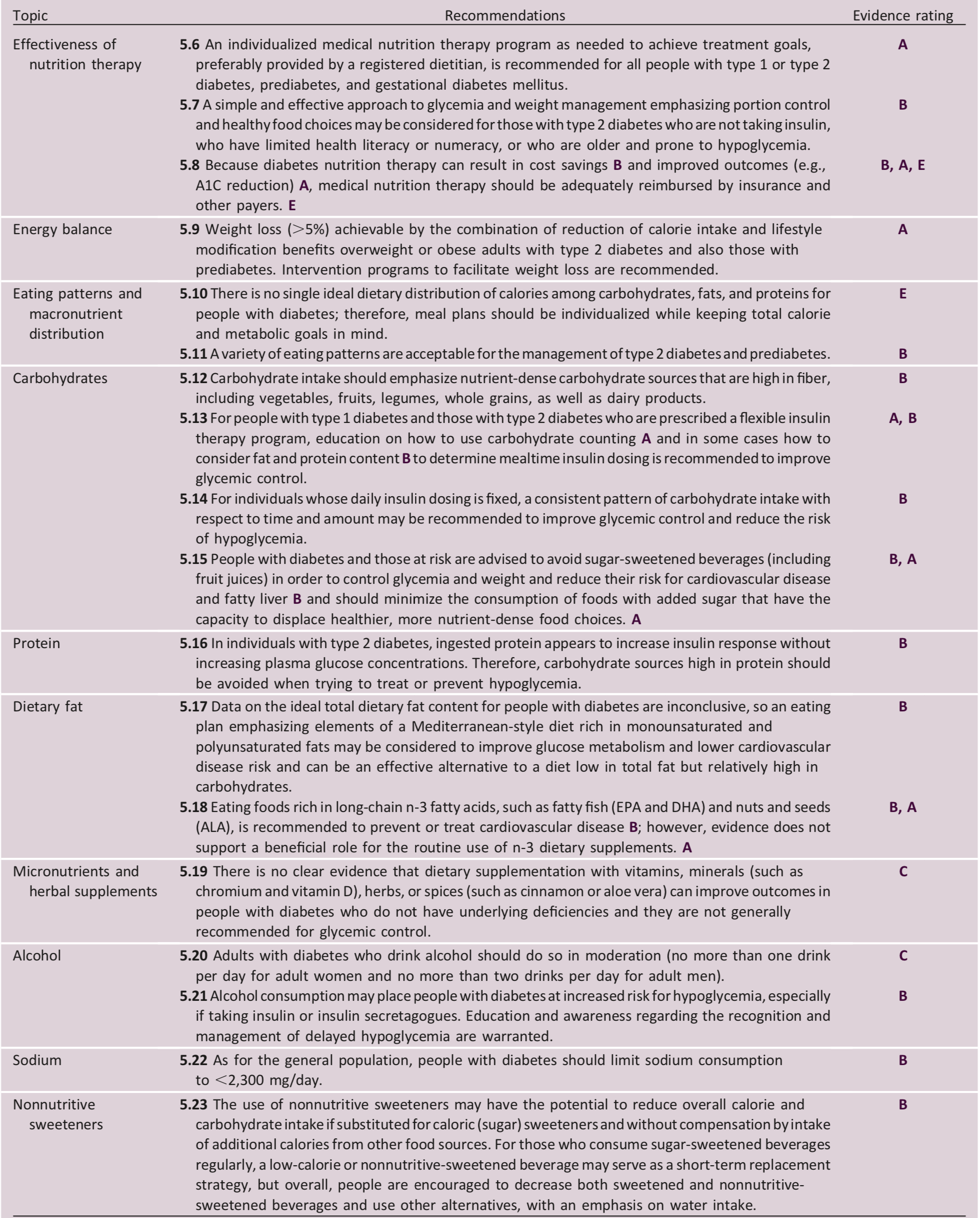
For many in­di­vid­u­als with di­a­betes, the most chal­leng­ing part of the treat­ment plan is de­ter­min­ing what to eat and fol­lowing a meal plan. There is not a one-‍size-‍fits-‍all eat­ing pat­tern for in­di­vid­u­als with di­a­betes, and meal plan­ning should be in­di­vid­u­alized. Nu­tri­tion ther­a­py has an in­te­gral role in over­all di­a­betes man­age­ment, and each per­son with di­a­betes should be ac­tively en­gaged in ed­u­ca­tion, self-‍man­age­ment, and treat­ment plan­ning with his or her health care team, in­clud­ing the col­lab­o­ra­tive de­vel­opment of an in­di­vid­u­alized eat­ing plan (35,48). All in­di­vid­u­als with di­a­betes should be of­fered a re­fer­ral for in­di­vid­u­alized MNT pro­vided by a reg­is­tered di­eti­tian (RD) who is knowl­edgeable and skilled in pro­vid­ing di­a­betes-‍specific MNT (49). MNT de­liv­ered by an RD is as­so­ci­at­ed with A1C de­creas­es of 1.0–1.9% for peo­ple with type 1 di­a­betes (50) and 0.3–2% for peo­ple with type 2 di­a­betes (50). See Table 5.1 for specific nu­tri­tion rec­om­men­da­tions. Be­cause of the pro­gres­sive na­ture of type 2 di­a­betes, lifestyle changes alone may not be ad­e­quate to main­tain eu­g­lycemia over time. How­ev­er, after med­i­ca­tion is ini­ti­at­ed, nu­tri­tion ther­a­py con­tin­ues to be an im­por­tant com­po­nent and should be in­te­grat­ed with the over­all treat­ment plan (48).

Table 5.1—Med­i­cal nu­tri­tion ther­a­py rec­om­men­da­tions

Table 5.1

xxxxx

3.2.0.0 Adults With DM, Goals of Nu­tri­tion Ther­a­py

  1. To pro­mote and sup­port health­ful eat­ing pat­terns, em­pha­siz­ing a va­ri­ety of nu­tri­ent-‍dense foods in ap­pro­pri­ate por­tion sizes, to im­prove over­all health and:
  2. Achieve and main­tain body weight goals

    At­tain in­di­vid­u­alized glycemic, blood pres­sure, and lipid goals

    Delay or pre­vent the com­pli­ca­tions of di­a­betes

  3. To ad­dress in­di­vid­u­al nu­tri­tion needs based on per­sonal and cul­tur­al pref­er­ences, health lit­er­a­cy and nu­mer­a­cy, ac­cess to health­ful foods, will­ing­ness and abil­i­ty to make be­hav­ioral changes, and bar­ri­ers to change
  4. To main­tain the plea­sure of eat­ing by pro­vid­ing nonjudg­men­tal mes­sages about food choic­es
  5. To pro­vide an in­di­vid­u­al with di­a­betes the prac­ti­cal tools for de­vel­oping healthy eat­ing pat­terns rather than fo­cus­ing on in­di­vid­u­al macronu­tri­ents, mi­cronu­tri­ents, or sin­gle foods

xxxxx

3.3.0.0 Eat­ing Pat­terns and Meal Plan­ning

Ev­i­dence sug­gests that there is not an ideal per­cent­age of calo­ries from car­bo­hy­drate, pro­tein, and fat for all peo­ple with di­a­betes. There­fore, macronu­tri­ent dis­tri­bu­tion should be based on an in­di­vid­u­alized as­sess­ment of cur­rent eat­ing pat­terns, pref­er­ences, and metabol­ic goals. Con­sid­er per­sonal pref­er­ences (e.g., tra­di­tion, cul­ture, re­li­gion, health be­liefs and goals, eco­nomics) as well as metabol­ic goals when work­ing with in­di­vid­u­als to de­ter­mine the best eat­ing pat­tern for them (35,51,52). It is im­por­tant that each mem­ber of the health care team be knowl­edgeable about nu­tri­tion ther­a­py prin­ci­ples for peo­ple with all types of di­a­betes and be sup­portive of their im­ple­mentation. Em­pha­sis should be on health­ful eat­ing pat­terns con­tain­ing nu­tri­ent-‍dense foods, with less focus on specific nu­tri­ents (53). A va­ri­ety of eat­ing pat­terns are ac­cept­able for the man­age­ment of di­a­betes (51,54), and a re­fer­ral to an RD or reg­is­tered di­eti­tian nu­tri­tionist (RDN) is es­sen­tial to as­sess the over­all nu­tri­tion sta­tus of, and to work col­lab­o­ra­tively with, the pa­tient to cre­ate a per­sonalized meal plan that con­sid­ers the in­di­vid­u­al’s health sta­tus, skills, re­sources, food pref­er­ences, and health goals to co­or­di­nate and align with the over­all treat­ment plan in­clud­ing phys­i­cal ac­tiv­i­ty and med­i­ca­tion. The Mediter­ranean (55,56), Di­etary Ap­proach­es to Stop Hy­per­ten­sion (DASH) (57-59), and plant-‍based (60,61) diets are all ex­am­ples of health­ful eat­ing pat­terns that have shown pos­i­tive re­sults in re­search, but in­di­vid­u­alized meal plan­ning should focus on per­sonal pref­er­ences, needs, and goals. In ad­di­tion, re­search in­di­cates that lowcar­bo­hy­drate eat­ing plans may re­sult in im­proved glycemia and have the po­ten­tial to re­duce an­ti­hy­per­glycemic med­i­ca­tions for in­di­vid­u­als with type 2 di­a­betes (62-64). As re­search stud­ies on some low-‍car­bo­hy­drate eat­ing plans gen­er­ally in­di­cate chal­lenges with longterm sus­tainabil­i­ty, it is im­por­tant to reas­sess and in­di­vid­u­alize meal plan guid­ance reg­u­lar­ly for those in­ter­est­ed in this ap­proach. This meal plan is not rec­om­mend­ed at this time for women who are preg­nant or lac­tat­ing, peo­ple with or at risk for dis­or­dered eat­ing, or peo­ple who have renal dis­ease, and it should be used with cau­tion in pa­tients tak­ing sodi­um–glu­cose co­trans­porter 2 (SGLT2) in­hibitors due to the po­ten­tial risk of ke­toaci­do­sis (65,66). There is inad­e­quate re­search in type 1 di­a­betes to sup­port one eat­ing plan over an­oth­er at this time.

A sim­ple and ef­fective ap­proach to glycemia and weight man­age­ment em­pha­siz­ing por­tion con­trol and healthy food choic­es should be con­sid­ered for those with type 2 di­a­betes who are not tak­ing in­sulin, who have lim­it­ed health lit­er­a­cy or nu­mer­a­cy, or who are older and prone to hy­po­glycemia (50). The di­a­betes plate method is com­mon­ly used for pro­vid­ing basic meal plan­ning guid­ance (67) as it pro­vides a vi­su­al guide show­ing how to con­trol calo­ries (by fea­tur­ing a small­er plate) and car­bo­hy­drates (by lim­it­ing them to what fits in one-‍quar­ter of the plate) and puts an em­pha­sis on low-‍car­bo­hy­drate (or non­starchy) veg­etables.

xxxxx

3.4.0.0 Weight Man­age­ment

Man­age­ment and re­duc­tion of weight is im­por­tant for peo­ple with type 1 di­a­betes, type 2 di­a­betes, or predi­a­betes who have over­weight or obe­si­ty. Lifestyle in­ter­ven­tion pro­grams should be in­ten­sive and have fre­quent fol­low-‍up to achieve significant re­duc­tions in ex­cess body weight and im­prove clin­i­cal in­di­ca­tors. There is strong and con­sis­tent ev­i­dence that mod­est per­sis­tent weight loss can delay the pro­gres­sion from predi­a­betes to type 2 di­a­betes (51,68,69) (see Sec­tion 3 “Pre­ven­tion or Delay of Type 2 Di­a­betes”) and is beneficial to the man­age­ment of type 2 di­a­betes (see Sec­tion 8 “Obe­si­ty Man­age­ment for the Treat­ment of Type 2 Di­a­betes”).

Stud­ies of re­duced calo­rie in­ter­ven­tions show re­duc­tions in A1C of 0.3% to 2.0% in adults with type 2 di­a­betes, as well as im­provements in med­i­ca­tion doses and qual­i­ty of life (50,51). Sus­tain­ing weight loss can be chal­leng­ing (70,71) but has long-‍term benefits; main­taining weight loss for 5 years is as­so­ci­at­ed with sus­tained im­provements in A1C and lipid lev­els (72). Weight loss can be at­tained with lifestyle pro­grams that achieve a 500–750 kcal/‍day en­er­gy deficit or pro­vide ˜1,200–1,500 kcal/‍day for women and 1,500–1,800 kcal/‍day for men, ad­just­ed for the in­di­vid­u­al’s base­line body weight. For many obese in­di­vid­u­als with type 2 di­a­betes, weight loss of at least 5% is need­ed to pro­duce beneficial out­comes in glycemic con­trol, lipids, and blood pres­sure (70). It should be noted, how­ev­er, that the clin­i­cal benefits of weight loss are pro­gres­sive and more in­ten­sive weight loss goals (i.e., 15%) may be ap­pro­pri­ate to max­i­mize benefit de­pend­ing on need, fea­si­bil­i­ty, and safe­ty (73). MNT guid­ance from an RD/‍RDN with ex­pertise in di­a­betes and weight man­age­ment, through­out the course of a struc­tured weight loss plan, is strong­ly rec­om­mend­ed.

Stud­ies have demon­strat­ed that a va­ri­ety of eat­ing plans, vary­ing in macronu­tri­ent com­po­si­tion, can be used ef­fectively and safe­ly in the short term (1–2 years) to achieve weight loss in peo­ple with di­a­betes. This in­cludes struc­tured low-‍calo­rie meal plans that in­clude meal re­place­ments (72-74) and the Mediter­ranean eat­ing pat­tern (75) as well as low-‍car­bo­hy­drate meal plans (62). How­ev­er, no sin­gle ap­proach has been proven to be con­sis­tently su­pe­ri­or (76,77), and more data are need­ed to iden­ti­fy and val­i­date those meal plans that are op­ti­mal with re­spect to longterm out­comes as well as pa­tient acceptabil­i­ty. The im­por­tance of pro­vid­ing guid­ance on an in­di­vid­u­alized meal plan con­tain­ing nu­tri­ent-‍dense foods, such as veg­etables, fruits, legumes, dairy, lean sources of pro­tein (in­clud­ing plant-‍based sources as well as lean meats, fish, and poul­try), nuts, seeds, and whole grains, can­not be overem­pha­sized (77), as well as guid­ance on achiev­ing the de­sired en­er­gy deficit (78-81). Any ap­proach to meal plan­ning should be in­di­vid­u­alized con­sid­ering the health sta­tus, per­sonal pref­er­ences, and abil­i­ty of the per­son with di­a­betes to sus­tain the rec­om­men­da­tions in the plan.

xxxxx

3.5.0.0 Car­bo­hy­drates

Stud­ies ex­am­in­ing the ideal amount of car­bo­hy­drate in­take for peo­ple with di­a­betes are in­con­clu­sive, al­though mon­i­tor­ing car­bo­hy­drate in­take and con­sid­ering the blood glu­cose re­sponse to di­etary car­bo­hy­drate are key for im­prov­ing post­pran­di­al glu­cose con­trol (82,83). The lit­er­a­ture con­cern­ing glycemic index and glycemic load in in­di­vid­u­als with di­a­betes is com­plex, often yield­ing mixed re­sults, though in some stud­ies low­er­ing the glycemic load of con­sumed car­bo­hy­drates has demon­strat­ed A1C re­duc­tions of 0.2% to 0.5% (84,85). Stud­ies longer than 12 weeks re­port no significant influence of glycemic index or glycemic load in­de­pen­dent of weight loss on A1C; how­ev­er, mixed re­sults have been re­port­ed for fast­ing glu­cose lev­els and en­doge­nous in­sulin lev­els.

For peo­ple with type 2 di­a­betes or predi­a­betes, low-‍car­bo­hy­drate eat­ing plans show po­ten­tial to im­prove glycemia and lipid out­comes for up to 1 year (62–64,86–89). Part of the chal­lenge in in­ter­pret­ing low-‍car­bo­hy­drate re­search has been due to the wide range of def­i­ni­tions for a low-‍car­bo­hy­drate eat­ing plan (85,86). As re­search stud­ies on low-‍car­bo­hy­drate eat­ing plans gen­er­ally in­di­cate chal­lenges with long-‍term sus­tainabil­i­ty, it is im­por­tant to reas­sess and in­di­vid­u­alize meal plan guid­ance reg­u­lar­ly for those in­ter­est­ed in this ap­proach. Providers should main­tain con­sis­tent med­i­cal over­sight and rec­og­nize that cer­tain groups are not ap­pro­pri­ate for low-‍car­bo­hy­drate eat­ing plans, in­clud­ing women who are preg­nant or lac­tat­ing, chil­dren, and peo­ple who have renal dis­ease or dis­or­dered eat­ing be­hav­ior, and these plans should be used with cau­tion for those tak­ing SGLT2 in­hibitors due to po­ten­tial risk of ke­toaci­do­sis (65,66). There is inad­e­quate re­search about di­etary pat­terns for type 1 di­a­betes to sup­port one eat­ing plan over an­oth­er at this time.

Most in­di­vid­u­als with di­a­betes re­port a mod­er­ate in­take of car­bo­hy­drate (44– 46% of total calo­ries) (51). Ef­forts to mod­i­fy ha­bit­u­al eat­ing pat­terns are often un­suc­cess­ful in the long term; peo­ple gen­er­ally go back to their usual macronu­tri­ent dis­tri­bu­tion (51). Thus, the rec­om­mend­ed ap­proach is to in­di­vid­u­alize meal plans to meet caloric goals with a macronu­tri­ent dis­tri­bu­tion that is more con­sis­tent with the in­di­vid­u­al’s usual in­take to in­crease the like­li­hood for long-‍term main­te­nance.

As for all in­di­vid­u­als in de­vel­oped coun­tries, both chil­dren and adults with di­a­betes are en­cour­aged to min­i­mize in­take of refined car­bo­hy­drates and added sug­ars and in­stead focus on car­bo­hy­drates from veg­etables, legumes, fruits, dairy (milk and yo­gurt), and whole grains. The con­sump­tion of sugar-‍sweet­ened bev­er­ages (in­clud­ing fruit juices) and pro­cessed “low-‍fat” or “non­fat” food prod­ucts with high amounts of refined grains and added sug­ars is strong­ly dis­cour­aged (90-92). In­di­vid­u­als with type 1 or type 2 di­a­betes tak­ing in­sulin at meal­time should be of­fered in­ten­sive and on­go­ing ed­u­ca­tion on the need to cou­ple in­sulin ad­min­is­tra­tion with car­bo­hy­drate in­take. For peo­ple whose meal sched­ule or car­bo­hy­drate con­sump­tion is vari­able, reg­u­lar coun­sel­ing to help them un­der­stand the com­plex re­la­tion­ship be­tween car­bo­hy­drate in­take and in­sulin needs is im­por­tant. In ad­di­tion, ed­u­ca­tion on using the in­sulin-to-car­bo­hy­drate ra­tios for meal plan­ning can as­sist them with ef­fectively mod­i­fying in­sulin dos­ing from meal to meal and im­prov­ing glycemic con­trol (51,82,93–96). In­di­vid­u­als who con­sume meals con­tain­ing more pro­tein and fat than usual may also need to make meal­time in­sulin dose ad­just­ments to com­pen­sate for de­layed post­pran­di­al glycemic ex­cur­sions (97-99). For in­di­vid­u­als on a fixed daily in­sulin sched­ule, meal plan­ning should em­pha­size a rel­a­tive­ly fixed car­bo­hy­drate con­sump­tion pat­tern with re­spect to both time and amount (35).

xxxxx

3.6.0.0 Pro­tein

There is no ev­i­dence that ad­just­ing the daily level of pro­tein in­take (typ­i­cal­ly 1–1.5 g/kg body weight/‍day or 15–20% total calo­ries) will im­prove health in in­di­vid­u­als with­out di­a­bet­ic kid­ney dis­ease, and re­search is in­con­clu­sive re­gard­ing the ideal amount of di­etary pro­tein to op­ti­mize ei­ther glycemic con­trol or car­dio­vas­cu­lar dis­ease (CVD) risk (84,100). There­fore, pro­tein in­take goals should be in­di­vid­u­alized based on cur­rent eat­ing pat­terns. Some re­search has found suc­cess­ful man­age­ment of type 2 di­a­betes with meal plans in­clud­ing slight­ly high­er lev­els of pro­tein (20–30%), which may con­tribute to in­creased sati­ety (58).

Those with di­a­bet­ic kid­ney dis­ease (with al­bu­min­uria and/‍or re­duced es­ti­mat­ed glomeru­lar filtra­tion rate) should aim to main­tain di­etary pro­tein at the rec­om­mend­ed daily al­lowance of 0.8 g/kg body weight/‍day. Re­duc­ing the amount of di­etary pro­tein below the rec­om­mend­ed daily al­lowance is not rec­om­mend­ed be­cause it does not alter glycemic mea­sures, car­dio­vas­cu­lar risk mea­sures, or the rate at which glomeru­lar filtra­tion rate de­clines (101,102).

In in­di­vid­u­als with type 2 di­a­betes, pro­tein in­take may en­hance or in­crease the in­sulin re­sponse to di­etary car­bo­hy­drates (103). There­fore, use of car­bo­hy­drate sources high in pro­tein (such as milk and nuts) to treat or pre­vent hy­po­glycemia should be avoid­ed due to the po­ten­tial concur­rent rise in en­doge­nous in­sulin.

xxxxx

3.7.0.0 Fats

The ideal amount of di­etary fat for in­di­vid­u­als with di­a­betes is con­tro­ver­sial. The Na­tion­al Acade­my of Medicine has defined an ac­cept­able macronu­tri­ent dis­tri­bu­tion for total fat for all adults to be 20–35% of total calo­rie in­take (104). The type of fats con­sumed is more im­por­tant than total amount of fat when look­ing at metabol­ic goals and CVD risk, and it is rec­om­mend­ed that the per­cent­age of total calo­ries from sat­u­rat­ed fats should be lim­it­ed (75,90,105–107). Mul­ti­ple ran­dom­ized con­trolled tri­als in­clud­ing pa­tients with type 2 di­a­betes have re­port­ed that a Mediter­ranean-‍style eat­ing pat­tern (75,108–113), rich in polyunsat­u­rat­ed and monounsat­u­rat­ed fats, can im­prove both glycemic con­trol and blood lipids. How­ev­er, sup­ple­ments do not seem to have the same ef­fects as their whole-‍food coun­ter­parts. A sys­tematic re­view con­clud­ed that di­etary sup­ple­ments with n-3 fatty acids did not im­prove glycemic con­trol in in­di­vid­u­als with type 2 di­a­betes (84). Ran­dom­ized con­trolled tri­als also do not sup­port rec­om­mend­ing n-3 sup­ple­ments for pri­ma­ry or sec­ondary pre­ven­tion of CVD (114-118). Peo­ple with di­a­betes should be ad­vised to fol­low the guide­lines for the gen­er­al pop­u­la­tion for the rec­om­mend­ed in­takes of sat­u­rat­ed fat, di­etary choles­terol, and trans fat (90). In gen­er­al, trans fats should be avoid­ed. In ad­di­tion, as sat­u­rat­ed fats are pro­gres­sively de­creased in the diet, they should be re­placed with unsat­u­rat­ed fats and not with refined car­bo­hy­drates (112).

xxxxx

3.8.0.0 Sodi­um

As for the gen­er­al pop­u­la­tion, peo­ple with di­a­betes are ad­vised to limit their sodi­um con­sump­tion to <2,300 mg/‍day (35). Re­stric­tion below 1,500 mg, even for those with hy­per­ten­sion, is gen­er­ally not rec­om­mend­ed (119-121). Sodi­um in­take rec­om­men­da­tions should take into ac­count palatabil­i­ty, availabil­i­ty, affordabil­i­ty, and the difficulty of achiev­ing low-‍sodi­um rec­om­men­da­tions in a nu­tri­tionally ad­e­quate diet (122).

xxxxx

3.9.0.0 Micronu­tri­ents and Sup­ple­ments

There con­tin­ues to be no clear ev­i­dence of benefit from herbal or non­herbal (i.e., vi­ta­min or min­er­al) sup­ple­men­ta­tion for peo­ple with di­a­betes with­out un­der­ly­ing deficien­cies (35). Met­formin is as­so­ci­at­ed with vi­ta­min B12 deficien­cy, with a re­cent re­port from the Di­a­betes Pre­ven­tion Pro­gram Out­comes Study (DPPOS) sug­gest­ing that pe­ri­od­ic test­ing of vi­ta­min B12 lev­els should be con­sid­ered in pa­tients tak­ing met­formin, par­tic­u­lar­ly in those with ane­mia or pe­riph­er­al neu­ropa­thy (123). Rou­tine sup­ple­men­ta­tion with an­tiox­i­dants, such as vi­ta­mins E and C and carotene, is not ad­vised due to lack of ev­i­dence of efficacy and con­cern re­lat­ed to long-‍term safe­ty. In ad­di­tion, there is insufficient ev­i­dence to sup­port the rou­tine use of herbals and mi­cronu­tri­ents, such as cin­na­mon (124), cur­cum­in, vi­ta­min D (125), or chromi­um, to im­prove glycemia in peo­ple with di­a­betes (35,126). How­ev­er, for spe­cial pop­u­la­tions, in­clud­ing preg­nant or lac­tat­ing women, older adults, veg­e­tar­i­ans, and peo­ple fol­lowing very low-‍calo­rie or low-‍car­bo­hy­drate diets, a multivi­ta­min may be nec­es­sary.

xxxxx

3.10.0.0 Al­co­hol

Mod­er­ate al­co­hol in­take does not have major detri­men­tal ef­fects on long-‍term blood glu­cose con­trol in peo­ple with di­a­betes. Risks as­so­ci­at­ed with al­co­hol con­sump­tion in­clude hy­po­glycemia (par­tic­u­lar­ly for those using in­sulin or in­sulin sec­re­t­a­gogue ther­a­pies), weight gain, and hy­per­glycemia (for those con­sum­ing ex­cessive amounts) (35,126). Peo­ple with di­a­betes can fol­low the same guide­lines as those with­out di­a­betes if they choose to drink. For women, no more than one drink per day, and for men, no more than two drinks per day is rec­om­mend­ed (one drink is equal to a 12-oz beer, a 5-oz glass of wine, or 1.5 oz of di­stil­led spir­its).

xxxxx

3.11.0.0 Non­nu­tri­tive Sweet­en­ers

For some peo­ple with di­a­betes who are ac­cus­tomed to sugar-‍sweet­ened prod­ucts, non­nu­tri­tive sweet­en­ers (con­tain­ing few or no calo­ries) may be an ac­cept­able sub­sti­tute for nu­tri­tive sweet­en­ers (those con­tain­ing calo­ries such as sugar, honey, agave syrup) when con­sumed in mod­er­a­tion. While use of non­nu­tri­tive sweet­en­ers does not ap­pear to have a significant ef­fect on glycemic con­trol (127), they can re­duce over­all calo­rie and car­bo­hy­drate in­take (51). Most sys­tematic re­views and me­ta­ana­ly­ses show benefits for non­nu­tri­tive sweet­en­er use in weight loss (128,129); how­ev­er, some re­search sug­gests an as­so­ci­a­tion with weight gain (130). Reg­u­la­to­ry agen­cies set ac­cept­able daily in­take lev­els for each non­nu­tri­tive sweet­en­er, defined as the amount that can be safe­ly con­sumed over a per­son’s life­time (35,131). For those who con­sume sugar-‍sweet­ened bev­er­ages reg­u­lar­ly, a low-‍calo­rie or non­nu­tri­tive-‍sweet­ened bev­er­age may serve as a short-‍term re­place­ment strat­e­gy, but over­all, peo­ple are en­cour­aged to de­crease both sweet­ened and non­nu­tri­tive-‍sweet­ened bev­er­ages and use other al­ter­na­tives, with an em­pha­sis on water in­take (132).

xxxxx

4.0.0.0 Phys­i­cal Ac­tiv­i­ty

4.1.0.0 Overview

Phys­i­cal ac­tiv­i­ty is a gen­er­al term that in­cludes all move­ment that in­creases en­er­gy use and is an im­por­tant part of the di­a­betes man­age­ment plan. Ex­er­cise is a more specific form of phys­i­cal ac­tiv­i­ty that is struc­tured and de­signed to im­prove phys­i­cal fitness. Both phys­i­cal ac­tiv­i­ty and ex­er­cise are im­por­tant.

Ex­er­cise has been shown to im­prove blood glu­cose con­trol, re­duce car­dio­vas­cu­lar risk fac­tors, con­tribute to weight loss, and im­prove well-‍being (133). Phys­i­cal ac­tiv­i­ty is as im­por­tant for those with type 1 di­a­betes as it is for the gen­er­al pop­u­la­tion, but its specific role in the pre­ven­tion of di­a­betes com­pli­ca­tions and the man­age­ment of blood glu­cose is not as clear as it is for those with type

2 di­a­betes. A re­cent study sug­gest­ed that the per­cent­age of peo­ple with di­a­betes who achieved the rec­om­mend­ed ex­er­cise level per week (150 min) var­ied by race. Ob­jec­tive mea­sure­ment by ac­celerom­e­ter showed that 44.2%, 42.6%, and 65.1% of whites, African Amer­i­cans, and His­pan­ics, re­spectively, met the thresh­old (134). It is im­por­tant for di­a­betes care man­age­ment teams to un­der­stand the difficulty that many pa­tients have reach­ing rec­om­mend­ed treat­ment tar­gets and to iden­ti­fy in­di­vid­u­alized ap­proaches to im­prove goal achieve­ment.

Mod­er­ate to high vol­umes of aer­o­bic ac­tiv­i­ty are as­so­ci­at­ed with sub­stan­tial­ly lower car­dio­vas­cu­lar and over­all mor­tal­i­ty risks in both type 1 and type 2 di­a­betes (135). A re­cent prospec­tive ob­ser­va­tion­al study of adults with type 1 di­a­betes sug­gest­ed that high­er amounts of phys­i­cal ac­tiv­i­ty led to re­duced car­dio­vas­cu­lar mor­tal­i­ty after a mean fol­low-‍up time of 11.4 years for pa­tients with and with­out chron­ic kid­ney dis­ease (136). Ad­di­tion­al­ly, struc­tured ex­er­cise in­ter­ven­tions of at least 8 weeks’ du­ra­tion have been shown to lower A1C by an av­er­age of 0.66% inpeo­plewithtype 2 di­a­betes, even with­out a sig­nif­i­cant change in BMI (137). There are also con­sid­erable data for the health benefits (e.g., in­creased car­dio­vas­cu­lar fitness, greater mus­cle strength, im­proved in­sulin sen­si­tiv­i­ty, etc.) of reg­u­lar ex­er­cise for those with type 1 di­a­betes (138). A re­cent study sug­gest­ed that ex­er­cise train­ing in type 1 di­a­betes may also im­prove sev­er­al im­por­tant mark­ers such as triglyc­eride level, LDL, waist cir­cum­fer­ence, and body mass (139). High­er lev­els of ex­er­cise in­ten­si­ty are as­so­ci­at­ed with greater im­provements in A1C and in fitness (140). Other benefits in­clude slow­ing the de­cline in mo­bil­i­ty among over­weight pa­tients with di­a­betes (141). The ADA po­si­tion state­ment “Phys­i­cal Ac­tiv­i­ty/Ex­er­cise and Di­a­betes” re­views the ev­i­dence for the benefits of ex­er­cise in peo­ple with type 1 and type 2 di­a­betes and of­fers specific rec­om­men­da­tion (142).

xxxxx

4.2.0.0 Rec­om­men­da­tions

5.24 Chil­dren and ado­les­cents with type 1 or type 2 di­a­betes or predi­a­betes should en­gage in 60 min/‍day or more of mod­er­ate-‍ or vig­or­ous-‍in­ten­si­ty aer­o­bic ac­tiv­i­ty, with vig­or­ous mus­cle-‍strengthening and bone-‍strength­en­ing ac­tiv­i­ties at least 3 days/‍week. C

5.25 Most adults with type 1 C and type 2 B di­a­betes should en­gage in 150 min or more of mod­er­ate-‍to-vig­or­ous in­ten­si­ty aer­o­bic ac­tiv­i­ty per week, spread over at least 3 days/‍week, with no more than 2 con­sec­u­tive days with­out ac­tiv­i­ty. Short­er du­ra­tions (min­i­mum 75 min/‍week) of vig­or­ous-‍in­ten­si­ty or in­ter­val train­ing may be sufficient for younger and more phys­i­cally fit in­di­vid­u­als.

5.26 Adults with type 1 C and type 2 B di­a­betes should en­gage in 2–3 ses­sions/‍week of re­sis­tance ex­er­cise on noncon­sec­u­tive days.

5.27 All adults, and par­tic­u­lar­ly those with type 2 di­a­betes, should de­crease the amount of time spent in daily seden­tary be­hav­ior. B Pro­longed sit­ting should be in­ter­rupt­ed every 30 min for blood glu­cose benefits, par­tic­u­lar­ly in adults with type 2 di­a­betes. C

5.28 Flex­i­bil­i­ty train­ing and bal­ance train­ing are rec­om­mend­ed 2–3 times/‍week for older adults with di­a­betes. Yoga and tai chi may be in­clud­ed based on in­di­vid­u­al pref­er­ences to in­crease flex­i­bil­i­ty, mus­cu­lar strength, and bal­ance. C

xxxxx

4.3.0.0 Ex­er­cise and Chil­dren

All chil­dren, in­clud­ing chil­dren with di­a­betes or predi­a­betes, should be en­cour­aged to en­gage in reg­u­lar phys­i­cal ac­tiv­i­ty. Chil­dren should en­gage in at least 60 min of mod­er­ate-‍to-vig­or­ous aer­o­bic ac­tiv­i­ty every day with mus­cle-‍ and bone-‍strength­en­ing ac­tiv­i­ties at least 3 days per week (143). In gen­er­al, youth with type 1 di­a­betes benefit from being phys­i­cally ac­tive, and an ac­tive lifestyle should be rec­om­mend­ed to all (144). Youth with type 1 di­a­betes who en­gage in more phys­i­cal ac­tiv­i­ty may have bet­ter health-‍re­lat­ed qual­i­ty of life (145).

xxxxx

4.4.0.0 Fre­quen­cy and Type of Phys­i­cal Ac­tiv­i­ty

Peo­ple with di­a­betes should per­form aer­o­bic and re­sis­tance ex­er­cise reg­u­lar­ly (142). Aer­o­bic ac­tiv­i­ty bouts should ide­al­ly last at least 10 min, with the goal of ˜30 min/‍day or more, most days of the week for adults with type 2 di­a­betes. Daily ex­er­cise, or at least not al­low­ing more than 2 days to elapse be­tween ex­er­cise ses­sions, is rec­om­mend­ed to de­crease in­sulin re­sis­tance, re­gard­less of di­a­betes type (146,147). Over time, ac­tiv­i­ties should progress in in­ten­si­ty, fre­quen­cy, and/‍or du­ra­tion to at least 150 min/‍week of mod­er­ate-‍in­ten­si­ty ex­er­cise. Adults able to run at 6 miles/‍h (9.7 km/h) for at least 25 min can benefit sufficient­ly from shorter-in­ten­si­ty ac­tiv­i­ty (75 min/‍week) (142). Many adults, in­clud­ing most with type 2 di­a­betes, would be un­able or un­will­ing to par­tic­i­pate in such in­tense ex­er­cise and should en­gage in mod­er­ate ex­er­cise for the rec­om­mend­ed du­ra­tion. Adults with di­a­betes should en­gage in 2–3 ses­sions/ week of re­sis­tance ex­er­cise on noncon­sec­u­tive days (148). Al­though heav­ier re­sis­tance train­ing with free weights and weight ma­chines may im­prove glycemic con­trol and strength (149), re­sis­tance train­ing of any in­ten­si­ty is rec­om­mend­ed to im­prove strength, bal­ance, and the abil­i­ty to en­gage in ac­tiv­i­ties of daily liv­ing through­out the life span. Providers and staff should help pa­tients set step­wise goals to­ward meet­ing the rec­om­mend­ed ex­er­cise tar­gets. Re­cent ev­i­dence sup­ports that all in­di­vid­u­als, in­clud­ing those with di­a­betes, should be en­cour­aged to re­duce the amount of time spent being seden­tary (e.g., work­ing at a com­put­er, watch­ing TV) by break­ing up bouts of seden­tary ac­tiv­i­ty (>30 min) by briefly stand­ing, walk­ing, or per­forming other light phys­i­cal ac­tiv­i­ties (150,151). Avoid­ing ex­tend­ed seden­tary pe­ri­ods may help pre­vent type 2 di­a­betes for those at risk and may also aid in glycemic con­trol for those with di­a­betes.

A wide range of ac­tiv­i­ties, in­clud­ing yoga, tai chi, and other types, can have significant im­pacts on A1C, flex­i­bil­i­ty, mus­cle strength, and bal­ance (133,152,153). Flex­i­bil­i­ty and bal­ance ex­er­cises may be par­tic­u­lar­ly im­por­tant in older adults with di­a­betes to main­tain range of mo­tion, strength, and bal­ance (142).

xxxxx

4.5.0.0 Phys­i­cal Ac­tiv­i­ty and Glycemic Con­trol

Clin­i­cal tri­als have pro­vided strong ev­i­dence for the A1C-‍low­er­ing value of re­sis­tance train­ing in older adults with type 2 di­a­betes (154) and for an ad­di­tive benefit of com­bined aer­o­bic and re­sis­tance ex­er­cise in adults with type 2 di­a­betes (155). If not contrain­di­cated, pa­tients with type 2 di­a­betes should be en­cour­aged to do at least two week­ly ses­sions of re­sis­tance ex­er­cise (ex­er­cise with free weights or weight ma­chines), with each ses­sion con­sist­ing of at least one set (group of con­sec­u­tive repet­i­tive ex­er­cise mo­tions) of five or more dif­fer­ent re­sis­tance ex­er­cises in­volv­ing the large mus­cle groups (154).

For type 1 di­a­betes, al­though ex­er­cise in gen­er­al is as­so­ci­at­ed with im­provement in dis­ease sta­tus, care needs to be taken in titrat­ing ex­er­cise with re­spect to glycemic man­age­ment. Each in­di­vid­u­al with type 1 di­a­betes has a vari­able glycemic re­sponse to ex­er­cise. This variabil­i­ty should be taken into con­sid­eration when rec­om­mend­ing the type and du­ra­tion of ex­er­cise for a given in­di­vid­u­al (138).

Women with pre­ex­ist­ing di­a­betes, par­tic­u­lar­ly type 2 di­a­betes, and those at risk for or pre­sent­ing with ges­ta­tion­al di­a­betes mel­li­tus should be ad­vised to en­gage in reg­u­lar mod­er­ate phys­i­cal ac­tiv­i­ty prior to and dur­ing their preg­nan­cies as tol­er­at­ed (142).

xxxxx

4.6.0.0 Pre-‍ex­er­cise Eval­u­a­tion

As dis­cussed more fully in Sec­tion 10 “Car­dio­vas­cu­lar Dis­ease and Risk Man­age­ment,” the best pro­to­col for as­sessing asymp­tomat­ic pa­tients with di­a­betes for coro­nary artery dis­ease re­mains un­clear. The ADA con­sen­sus re­port “Screen­ing for Coro­nary Artery Dis­ease in Pa­tients With Di­a­betes” (156) con­clud­ed that rou­tine test­ing is not rec­om­mend­ed. How­ev­er, pro­viders should per­form a care­ful his­to­ry, as­sess car­dio­vas­cu­lar risk fac­tors, and be aware of the atyp­i­cal pre­sen­ta­tion of coro­nary artery dis­ease in pa­tients with di­a­betes. Cer­tain­ly, high-‍risk pa­tients should be en­cour­aged to start with short pe­ri­ods of low-‍in­ten­si­ty ex­er­cise and slow­ly in­crease the in­ten­si­ty and du­ra­tion as tol­er­at­ed. Providers should as­sess pa­tients for con­di­tions that might contrain­di­cate cer­tain types of ex­er­cise or pre­dis­pose to in­jury, such as uncon­trolled hy­per­ten­sion, un­treat­ed pro­lif­er­a­tive retinopa­thy, au­to­nom­ic neu­ropa­thy, pe­riph­er­al neu­ropa­thy, and a his­to­ry of foot ul­cers or Char­cot foot. The pa­tient’s age and pre­vi­ous phys­i­cal ac­tiv­i­ty level should be con­sid­ered. The pro­vider should cus­tomize the ex­er­cise reg­i­men to the in­di­vid­u­al’s needs. Those with com­pli­ca­tions may re­quire a more thor­ough eval­u­a­tion prior to be­gin­ning an ex­er­cise pro­gram (138).

xxxxx

4.7.0.0 Hy­po­glycemia

In in­di­vid­u­als tak­ing in­sulin and/‍or in­sulin sec­re­t­a­gogues, phys­i­cal ac­tiv­i­ty may cause hy­po­glycemia if the med­i­ca­tion dose or car­bo­hy­drate con­sump­tion is not al­tered. In­di­vid­u­als on these ther­a­pies may need to in­gest some added car­bo­hy­drate if pre-‍ex­er­cise glu­cose lev­els are <90 mg/dL (5.0 mmol/‍L), de­pend­ing on whether they are able to lower in­sulin doses dur­ing the work­out (such as with an in­sulin pump or re­duced pre-‍ex­er­cise in­sulin dosage), the time of day ex­er­cise is done, and the in­ten­si­ty and du­ra­tion of the ac­tiv­i­ty (138,142). In some pa­tients, hy­po­glycemia after ex­er­cise may occur and last for sev­er­al hours due to in­creased in­sulin sen­si­tiv­i­ty. Hy­po­glycemia is less com­mon in pa­tients with di­a­betes who are not treat­ed with in­sulin or in­sulin sec­re­t­a­gogues, and no rou­tine pre­ven­tive mea­sures for hy­po­glycemia are usu­al­ly ad­vised in these cases. In­tense ac­tiv­i­ties may ac­tu­al­ly raise blood glu­cose lev­els in­stead of low­er­ing them, espe­cially if pre-‍ex­er­cise glu­cose lev­els are el­e­vat­ed (157).

xxxxx

4.8.0.0 Ex­er­cise in the Pres­ence of Spe­cif­ic Long-‍term Com­pli. of DM

4.8.1.0 Retinopa­thy

See Sec­tion 11 “Mi­crovas­cu­lar Com­plications and Foot Care” for more in­for­ma­tion on these long-‍term com­pli­ca­tions.

Retinopa­thy

If pro­lif­er­a­tive di­a­bet­ic retinopa­thy or se­vere nonpro­lif­er­a­tive di­a­bet­ic retinopa­thy is pre­sent, then vig­or­ous-‍in­ten­si­ty aer­o­bic or re­sis­tance ex­er­cise may be contrain­di­cated be­cause of the risk of trig­ger­ing vit­re­ous hem­or­rhage or reti­nal de­tach­ment (158). Con­sul­ta­tion with an oph­thal­mol­o­gist prior to en­gag­ing in an in­tense ex­er­cise reg­i­men may be ap­pro­pri­ate.

xxxxx

4.8.2 Pe­riph­er­al Neu­ropa­thy

De­creased pain sen­sa­tion and a high­er pain thresh­old in the ex­trem­i­ties re­sult in an in­creased risk of skin break­down, in­fec­tion, and Char­cot joint de­struc­tion with some forms of ex­er­cise. There­fore, a thor­ough as­sess­ment should be done to en­sure that neu­ropa­thy does not alter kines­thet­ic or pro­pri­o­cep­tive sen­sa­tion dur­ing phys­i­cal ac­tiv­i­ty, par­tic­u­lar­ly in those with more se­vere neu­ropa­thy. Stud­ies have shown that mod­er­ate-‍in­ten­si­ty walk­ing may not lead to an in­creased risk of foot ul­cers or reul­cer­a­tion in those with pe­riph­er­al neu­ropa­thy who use prop­er footwear (159). In ad­di­tion, 150 min/‍week of mod­er­ate ex­er­cise was re­port­ed to im­prove out­comes in pa­tients with predi­a­bet­ic neu­ropa­thy (160). All in­di­vid­u­als with pe­riph­er­al neu­ropa­thy should wear prop­er footwear and ex­am­ine their feet daily to de­tect le­sions early. Any­one with a foot in­jury or open sore should be re­strict­ed to non–weight-‍bear­ing ac­tiv­i­ties.

xxxxx

4.8.3.0 Au­to­nom­ic Neu­ropa­thy

Au­to­nom­ic neu­ropa­thy can in­crease the risk of ex­er­cise-induced in­jury or ad­verse events through de­creased car­diac re­spon­siveness to ex­er­cise, pos­tu­ral hy­poten­sion, im­paired ther­moreg­u­la­tion, im­paired night vi­sion due to im­paired pap­il­lary re­ac­tion, and greater sus­cep­ti­bil­i­ty to hy­po­glycemia (161). Car­dio­vas­cu­lar au­to­nom­ic neu­ropa­thy is also an in­de­pen­dent risk fac­tor for car­dio­vas­cu­lar death and silent my­ocar­dial is­chemia (162). There­fore, in­di­vid­u­als with di­a­bet­ic au­to­nom­ic neu­ropa­thy should un­der­go car­diac in­ves­ti­ga­tion be­fore be­gin­ning phys­i­cal ac­tiv­i­ty more in­tense than that to which they are ac­cus­tomed.

xxxxx

4.8.4.0 Di­a­bet­ic Kid­ney Dis­ease

Phys­i­cal ac­tiv­i­ty can acute­ly in­crease uri­nary al­bu­min ex­cre­tion. How­ev­er, there is no ev­i­dence that vig­or­ous-‍in­ten­si­ty ex­er­cise in­creases the rate of pro­gres­sion of di­a­bet­ic kid­ney dis­ease, and there ap­pears to be no need for specific ex­er­cise re­stric­tions for peo­ple with di­a­bet­ic kid­ney dis­ease in gen­er­al (158).

xxxxx

5.0.0.0 Smok­ing Ces­sa­tion: To­bac­co and e-‍Cigarettes

5.1.0.0 Overview

Re­sults from epi­demi­o­log­i­cal, case-‍con­trol, and co­hort stud­ies pro­vide con­vinc­ing ev­i­dence to sup­port the causal link be­tween cigarette smok­ing and health risks (163). Re­cent data show to­bac­co use is high­er among adults with chron­ic con­di­tions (164) as well as in ado­les­cents and young adults with di­a­betes (165). Smok­ers with di­a­betes (and peo­ple with di­a­betes ex­posed to sec­ond-‍hand smoke) have a height­ened risk of CVD, pre­ma­ture death, mi­crovas­cu­lar com­pli­ca­tions, and worse glycemic con­trol when com­pared with non­smok­ers (166,167). Smok­ing may have a role in the de­vel­opment of type 2 di­a­betes (168-171).

The rou­tine and thor­ough as­sess­ment of to­bac­co use is es­sen­tial to pre­vent smok­ing or en­cour­age ces­sa­tion. Nu­mer­ous large ran­dom­ized clin­i­cal tri­als have demon­strat­ed the efficacy and cost-‍ef­fec­tiveness of brief coun­sel­ing in smok­ing ces­sa­tion, in­clud­ing the use of tele­phone quit lines, in re­duc­ing to­bac­co use. Phar­ma­co­log­ic ther­a­py to as­sist with smok­ing ces­sa­tion in peo­ple with di­a­betes has been shown to be ef­fective (172), and for the pa­tient mo­ti­vat­ed to quit, the ad­di­tion of phar­ma­co­log­ic ther­a­py to coun­sel­ing is more ef­fective than ei­ther treat­ment alone (173). Spe­cial con­sid­erations should in­clude as­sess­ment of level of nico­tine de­pen­dence, which is as­so­ci­at­ed with difficulty in quit­ting and re­lapse (174). Al­though some pa­tients may gain weight in the pe­ri­od short­ly after smok­ing ces­sa­tion (175), re­cent re­search has demon­strat­ed that this weight gain does not di­min­ish the sub­stan­tial CVD benefit re­al­ized from smok­ing ces­sa­tion (176). One study in smok­ers with newly di­ag­nosed type 2 di­a­betes found that smok­ing ces­sa­tion was as­so­ci­at­ed with ame­lio­ra­tion of metabol­ic pa­ram­e­ters and re­duced blood pres­sure and al­bu­min­uria at 1 year (177).

In re­cent years e-‍cigarettes have gained pub­lic aware­ness and pop­u­lar­i­ty be­cause of per­cep­tions that e-‍cigarette use is less harm­ful than reg­u­lar cigarette smok­ing (178,179). Nonsmok­ers should be ad­vised not to use e-‍cigarettes (180,181). There are no rig­or­ous stud­ies that have demon­strat­ed that e-‍cigarettes are a health­i­er al­ter­na­tive to smok­ing or that e-‍cigarettes can fa­cil­i­tate smok­ing ces­sa­tion (182). On the con­trary, a re­cently pub­lished prag­mat­ic trial found that use of e-‍cigarettes for smok­ing ces­sa­tion was not more ef­fective than “usual care,” which in­clud­ed ac­cess to ed­u­ca­tional in­for­ma­tion on the health benefits of smok­ing ces­sa­tion, strate­gies to pro­mote ces­sa­tion, and ac­cess to a free text-‍mes­sag­ing ser­vice that pro­vided en­cour­agement, ad­vice, and tips to fa­cil­i­tate smok­ing ces­sa­tion (183). Sev­er­al or­ga­ni­za­tions have called for more re­search on the short-‍ and long-‍term safe­ty and health ef­fects of e-‍cigarettes (184-186).

xxxxx

5.2.0.0 Rec­om­men­da­tions

5.29 Ad­vise all pa­tients not to use cigarettes and other to­bac­co prod­ucts A or e-‍cigarettes. B

5.30 In­clude smok­ing ces­sa­tion coun­sel­ing and other forms of treat­ment as a rou­tine com­po­nent of di­a­betes care. A

xxxxx

6.0.0.0 Psychoso­cial Is­sues

6.1.0.0 Overview

Please refer to the ADA po­si­tion state­ment “Psychoso­cial Care for Peo­ple With Di­a­betes” for a list of as­sess­ment tools and ad­di­tional de­tails (187).

Com­plex en­vi­ron­men­tal, so­cial, be­hav­ioral, and emo­tion­al fac­tors, known as psy­choso­cial fac­tors, influence liv­ing with di­a­betes, both type 1 and type 2, and achiev­ing satisfac­tory med­i­cal out­comes and psy­cho­log­i­cal well-‍being. Thus, in­di­vid­u­als with di­a­betes and their fam­i­lies are chal­lenged with com­plex, mul­ti­faceted is­sues when in­te­grat­ing di­a­betes care into daily life.

Emo­tional well-‍being is an im­por­tant part of di­a­betes care and self-‍man­age­ment. Psy­cho­log­i­cal and so­cial prob­lems can im­pair the in­di­vid­u­al’s (188-190) or fam­i­ly’s (191) abil­i­ty to carry outdi­a­betes care tasks and there­fore po­ten­tial­ly com­pro­mise health sta­tus. There are op­por­tu­ni­ties for the clin­i­cian to rou­tinely as­sess psy­choso­cial sta­tus in a time­ly and efficient man­ner for re­fer­ral to ap­pro­pri­ate ser­vices. A sys­tematic re­view and meta-‍anal­y­sis showed that psy­choso­cial in­ter­ven­tions mod­estly but sig­nif­i­cant­ly im­proved A1C (stan­dard­ized mean dif­fer­ence –0.29%) and men­tal health out­comes (192). How­ev­er, there was a lim­it­ed as­so­ci­a­tion be­tween the ef­fects on A1C and men­tal health, and no in­ter­ven­tion char­ac­ter­is­tics pre­dict­ed benefit on both out­comes.

xxxxx

6.2.0.0 Rec­om­men­da­tions

Rec­om­men­da­tions

5.31 Psychoso­cial care should be in­te­grat­ed with a col­lab­o­ra­tive, pa­tient-‍cen­tered ap­proach and pro­vided to all peo­ple with di­a­betes, with the goals of op­ti­miz­ing health out­comes and health-‍re­lat­ed qual­i­ty of life. A

5.32 Psychoso­cial screen­ing and fol­low-‍up may in­clude, but are not lim­it­ed to, at­ti­tudes about di­a­betes, ex­pec­ta­tions for med­i­cal man­age­ment and out­comes, af­fect or mood, gen­er­al and di­a­betes-‍re­lat­ed qual­i­ty of life, avail­able re­sources (finan­cial, so­cial, and emo­tion­al), and psy­chi­atric his­to­ry. E

5.33 Providers should con­sid­er as­sess­ment for symp­toms of di­a­betes dis­tress, de­pres­sion, anx­i­ety, dis­or­dered eat­ing, and cog­ni­tive ca­pac­i­ties using pa­tient-‍ap­pro­pri­ate stan­dard­ized and val­i­dated tools at the ini­tial visit, at pe­ri­od­ic in­ter­vals, and when there is a change in dis­ease, treat­ment, or life cir­cum­stance. In­clud­ing care­givers and fam­i­ly mem­bers in this as­sess­ment is rec­om­mend­ed. B

5.34 Con­sid­er screen­ing older adults (aged ≥65 years) with di­a­betes for cog­ni­tive im­pairment and de­pres­sion. B

xxxxx

6.3.0.0 Screen­ing

Key op­por­tu­ni­ties for psy­choso­cial screen­ing occur at di­a­betes di­ag­no­sis, dur­ing reg­u­lar­ly sched­uled man­age­ment vis­its, dur­ing hos­pi­talizations, with new onset of com­pli­ca­tions, or when prob­lems with glu­cose con­trol, qual­i­ty of life, or self-‍man­age­ment are iden­tified (1). Pa­tients are like­ly to ex­hib­it psy­cho­log­i­cal vulnerabil­i­ty at di­ag­no­sis, when their med­i­cal sta­tus changes (e.g., end of the hon­ey­moon pe­ri­od), when the need for in­ten­sified treat­ment is ev­i­dent, and when com­pli­ca­tions are discov­ered.

Providers can start with in­for­mal ver­bal in­quires, for ex­am­ple, by ask­ing if there have been changes in mood dur­ing the past 2 weeks or since the pa­tient’s last visit. Providers should con­sid­er ask­ing if there are new or dif­fer­ent bar­ri­ers to treat­ment and self-‍man­age­ment, such as feel­ing over­whelmed or stressed by di­a­betes or other life stres­sors. Stan­dard­ized and val­i­dated tools for psy­choso­cial mon­i­tor­ing and as­sess­ment can also be used by pro­viders (187), with pos­i­tive find­ings lead­ing to re­fer­ral to a men­tal health pro­vider spe­cializing in di­a­betes for com­pre­hen­sive eval­u­a­tion, di­ag­no­sis, and treat­ment.

xxxxx

6.4.0.0 Di­a­betes Dis­tress

6.4.1.0 Overview

Di­a­betes dis­tress (DD) is very com­mon and is dis­tinct from other psy­cho­log­i­cal dis­or­ders (193-195). DD refers to sig­nif­i­cant neg­a­tive psy­cho­log­i­cal re­ac­tions re­lat­ed to emo­tion­al bur­dens and wor­ries specific to an in­di­vid­u­al’s ex­pe­ri­ence in hav­ing to man­age a se­vere, com­pli­cat­ed, and de­mand­ing chron­ic dis­ease such as di­a­betes (194-196). The con­stant be­hav­ioral de­mands (med­i­ca­tion dos­ing, fre­quen­cy, and titra­tion; mon­i­tor­ing blood glu­cose, food in­take, eat­ing pat­terns, and phys­i­cal ac­tiv­i­ty) of di­a­betes self-‍man­age­ment and the po­ten­tial or ac­tu­al­i­ty of dis­ease pro­gres­sion are di­rect­ly as­so­ci­at­ed with re­ports of DD (194). The preva­lence of DD is re­port­ed to be 18–45% with an in­ci­dence of 38–48% over 18 months (196). In the sec­ond Di­a­betes At­ti­tudes, Wish­es and Needs (DAWN2) study, significant DD was re­port­ed by 45% of the par­tic­i­pants, but only 24% re­port­ed that their health care teams asked them how di­a­betes af­fected their lives (193). High lev­els of DD significant­ly im­pact med­i­ca­tiontak­ing be­hav­iors and are linked to high­er A1C, lower self-‍efficacy, and poor­er di­etary and ex­er­cise be­hav­iors (17,194, 196). DSMES has been shown to re­duce DD (17). It may be help­ful to pro­vide coun­sel­ing re­gard­ing ex­pect­ed di­a­betes-‍re­lat­ed ver­sus gen­er­alized psy­cho­log­i­cal dis­tress at di­ag­no­sis and when dis­ease state or treat­ment changes (197).

DD should be rou­tinely mon­i­tored (198) using pa­tient-‍ap­pro­pri­ate val­i­dated mea­sures (187). If DD is iden­tified, the per­son should be re­ferred for specific di­a­betes ed­u­ca­tion to ad­dress areas of di­a­betes self-‍care that are most rel­e­vant to the pa­tient and im­pact clin­i­cal man­age­ment. Peo­ple whose self-‍care re­mains im­paired after tai­lored di­a­betes ed­u­ca­tion should be re­ferred by their care team to a be­hav­ioral health pro­vider for eval­u­a­tion and treat­ment.

Other psy­choso­cial is­sues known to af­fect self-‍man­age­ment and health out­comes in­clude at­ti­tudes about the ill­ness, ex­pec­ta­tions for med­i­cal man­age­ment and out­comes, avail­able re­sources (finan­cial, so­cial, and emo­tion­al) (199), and psy­chi­atric his­to­ry. For ad­di­tional in­for­ma­tion on psy­chi­atric co­mor­bidities (de­pres­sion, anx­i­ety, dis­or­dered eat­ing, and se­ri­ous men­tal ill­ness), please refer to Sec­tion 4 “Com­pre­hen­sive Med­i­cal Eval­u­a­tion and As­sess­ment of Co­mor­bidi­ties.”

xxxxx

6.4.2.0 Rec­om­men­da­tions

5.35 Rou­tinely mon­i­tor peo­ple with di­a­betes for di­a­betes dis­tress, par­tic­u­lar­ly when treat­ment tar­gets are not met and/‍or at the onset of di­a­betes com­pli­ca­tions. B

xxxxx

6.5.0.0 Re­fer­ral to a Men­tal Health Spe­cialist

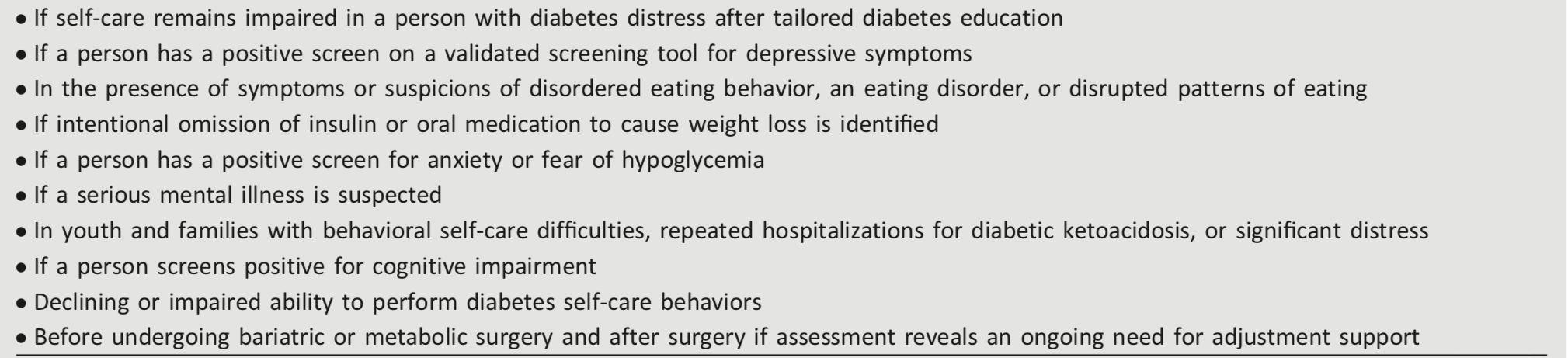
In­di­ca­tions for re­fer­ral to a men­tal health spe­cialist fa­mil­iar with di­a­betes man­age­ment may in­clude pos­i­tive screen­ing for over­all stress re­lat­ed to work-‍life bal­ance, DD, di­a­betes man­age­ment difficul­ties, de­pres­sion, anx­i­ety, dis­or­dered eat­ing, and cog­ni­tive dys­func­tion (see Table 5.2 for a com­plete list). It is prefer­able to in­cor­po­rate psy­choso­cial as­sess­ment and treat­ment into rou­tine care rather than wait­ing for a specific prob­lem or de­te­ri­o­ra­tion in metabol­ic or psy­cho­log­i­cal sta­tus to occur (26,193). Providers should iden­ti­fy be­hav­ioral and men­tal health pro­viders, ide­al­ly those who are knowl­edgeable about di­a­betes treat­ment and the psy­choso­cial as­pects of di­a­betes, to whom they can refer pa­tients. The ADA pro­vides a list of men­tal health pro­viders who have re­ceived ad­di­tional ed­u­ca­tion in di­a­betes at the ADA Men­tal Health Provider Di­rec­to­ry (pro­fes­sion­al. di­a­betes.org/ada-men­tal-health-pro­vider-directory). Ide­al­ly, psy­choso­cial care pro­viders should be em­bed­ded in di­a­betes care set­tings. Al­though the clin­i­cian may not feel qualified to treat psy­cho­log­i­cal prob­lems (200), op­ti­miz­ing the pa­tient-pro­vider re­la­tion­ship as a foun­da­tion may in­crease the like­li­hood of the pa­tient ac­cept­ing re­fer­ral for other ser­vices. Col­lab­o­ra­tive care in­ter­ven­tions and a team ap­proach have demon­strat­ed efficacy in di­a­betes self-‍man­age­ment, out­comes of de­pres­sion, and psy­choso­cial func­tion­ing (17,201).

Table 5.2—Sit­u­a­tions that war­rant re­fer­ral of a per­son with di­a­betes to a men­tal health pro­vider for eval­u­a­tion and treat­ment

Table 5.2

xxxxx

7.0.0.0 Ref­er­ences

  1. Pow­ers MA, Bard­s­ley J, Cy­press M, et al. Di­a­betes self-‍man­age­ment ed­u­ca­tion and sup­port in type 2 di­a­betes: a joint po­si­tion state­ment of the Amer­i­can Di­a­betes As­so­ci­a­tion, the Amer­i­can As­so­ci­a­tion of Di­a­betes Ed­u­ca­tors, and the Acade­my of Nu­tri­tion and Di­etet­ics. Di­a­betes Care 2015;38:1372–1382
  2. Dick­in­son JK, Guz­man SJ, Maryniuk MD, et al. The use of lan­guage in di­a­betes care and ed­u­ca­tion. Di­a­betes Care 2017;40:1790–1799
  3. Dick­in­son JK, Maryniuk MD. Build­ing ther­a­peu­tic re­la­tion­ships: choos­ing words that put peo­ple first. Clin Di­a­betes 2017;35:51–54
  4. Beck J, Green­wood DA, Blan­ton L, et al.; 2017 Stan­dards Revi­sion Task Force. 2017 na­tion­al stan­dards for di­a­betes self-‍man­age­ment ed­u­ca­tion and sup­port. Di­a­betes Care 2017;40:1409– 1419
  5. Tang TS, Fun­nell MM, Brown MB, Kur­lan­der JE. Self-‍man­age­ment sup­port in “real-‍world” set­tings: an em­pow­er­ment-‍based in­ter­ven­tion. Pa­tient Educ Couns 2010;79:178–184
  6. Mar­rero DG, Ard J, De­la­mater AM, et al. Twenty-‍first cen­tu­ry be­hav­ioral medicine: a con­text for em­pow­er­ing clin­i­cians and pa­tients with di­a­betes: a con­sen­sus re­port. Di­a­betes Care 2013;36:463–470
  7. Nor­ris SL, Lau J, Smith SJ, Schmid CH, En­gel­gau MM. Self-‍man­age­ment ed­u­ca­tion for adults with type 2 di­a­betes: a meta-‍anal­y­sis of the ef­fect on glycemic con­trol. Di­a­betes Care 2002; 25:1159–1171
  8. Haas L, Maryniuk M, Beck J, et al.; 2012 Stan­dards Revi­sion Task Force. Na­tion­al stan­dards for di­a­betes self-‍man­age­ment ed­u­ca­tion and sup­port. Di­a­betes Care 2014;37(Suppl. 1): S144–S153
  9. Frosch DL, Uy V, Ochoa S, Man­gione CM. Eval­u­a­tion of a be­hav­ior sup­port in­ter­ven­tion for pa­tients with poor­ly con­trolled di­a­betes. Arch In­tern Med 2011;171:2011–2017
  10. Cooke D, Bond R, Law­ton J, et al.; U.K. NIHR DAFNE Study Group. Struc­tured type 1 di­a­betes ed­u­ca­tion de­liv­ered with­in rou­tine care: im­pact on glycemic con­trol and di­a­betes-‍specific qual­i­ty of life. Di­a­betes Care 2013;36:270– 272
  11. Chrvala CA, Sherr D, Lip­man RD. Di­a­betes self-‍man­age­ment ed­u­ca­tion for adults with type 2 di­a­betes mel­li­tus: a sys­tematic re­view of the ef­fect on glycemic con­trol. Pa­tient Educ Couns 2016;99:926–943
  12. Steins­bekk A, Rygg LØ, Lisu­lo M, Rise MB, Fretheim A. Group based di­a­betes self-‍man­age­ment ed­u­ca­tion com­pared to rou­tine treat­ment for peo­ple with type 2 di­a­betes mel­li­tus. A sys­tematic re­view with meta-‍anal­y­sis. BMC Health Serv Res 2012;12:213
  13. Deakin T, Mc­Shane CE, Cade JE, Williams RD. Group based train­ing for self-‍man­age­ment strate­gies in peo­ple with type 2 di­a­betes mel­li­tus. Cochrane Database Syst Rev 2005;2: CD003417
  14. Cochran J, Conn VS. Meta-‍anal­y­sis of qual­i­ty of life out­comes fol­lowing di­a­betes self-‍man­age­ment train­ing. Di­a­betes Educ 2008;34: 815–823
  15. He X, Li J, Wang B, et al. Di­a­betes self-‍man­age­ment ed­u­ca­tion re­duces risk of all-‍cause mor­tal­i­ty in type 2 di­a­betes pa­tients: a sys­tematic re­view and meta-‍anal­y­sis. En­docrine 2017; 55:712–731
  16. Thor­pe CT, Fahey LE, John­son H, Desh­pande M, Thor­pe JM, Fish­er EB. Fa­cil­i­tat­ing healthy cop­ing in pa­tients with di­a­betes: a sys­tematic re­view. Di­a­betes Educ 2013;39:33–52
  17. Fish­er L, Hessler D, Glas­gow RE, et al. RE­DEEM: a prag­mat­ic trial to re­duce di­a­betes dis­tress. Di­a­betes Care 2013;36:2551–2558
  18. Rob­bins JM, Thatch­er GE, Webb DA, Vald­ma­n­is VG. Nu­tri­tionist vis­its, di­a­betes class­es, and hos­pi­talization rates and charges: the Urban Di­a­betes Study. Di­a­betes Care 2008;31: 655–660
  19. Dun­can I, Ahmed T, Li QE, et al. As­sess­ing the value of the di­a­betes ed­u­ca­tor. Di­a­betes Educ 2011;37:638–657
  20. Straw­bridge LM, Lloyd JT, Mead­ow A, Riley GF, How­ell BL. One-‍year out­comes of di­a­betes self-‍man­age­ment train­ing among Medi­care beneficia­ries newly di­ag­nosed with di­a­betes. Med Care 2017;55:391–397
  21. Piatt GA, An­der­son RM, Brooks MM, et al. 3-year fol­low-‍up of clin­i­cal and be­hav­ioral im­provements fol­lowing a mul­ti­faceted di­a­betes care in­ter­ven­tion: re­sults of a ran­dom­ized con­trolled trial. Di­a­betes Educ 2010;36:301–309
  22. Glazier RH, Ba­j­car J, Ken­nie NR, Will­son K. A sys­tematic re­view of in­ter­ven­tions to im­prove di­a­betes care in so­cially dis­ad­van­taged pop­u­la­tions. Di­a­betes Care 2006;29:1675–1688
  23. Hawthorne K, Rob­les Y, Cannings-‍John R, Ed­wards AG. Cul­tu­ral­ly ap­pro­pri­ate health ed­u­ca­tion for type 2 di­a­betes mel­li­tus in eth­nic mi­nor­i­ty groups. Cochrane Database Syst Rev 2008;3:CD006424
  24. Cho­dosh J, Mor­ton SC, Mo­ji­ca W, et al. Meta­anal­y­sis: chron­ic dis­ease self-‍man­age­ment pro­grams for older adults. Ann In­tern Med 2005; 143:427–438
  25. Sark­isian CA, Brown AF, Nor­ris KC, Wintz RL, Man­gione CM. A sys­tematic re­view of di­a­betes self-‍care in­ter­ven­tions for older, African Amer­i­can, or Lati­no adults. Di­a­betes Educ 2003;29: 467–479
  26. Pey­rot M, Rubin RR. Be­hav­ioral and psy­choso­cial in­ter­ven­tions in di­a­betes: a con­cep­tu­al re­view. Di­a­betes Care 2007;30:2433–2440
  27. Naik AD, Palmer N, Pe­tersen NJ, et al. Com­par­a­tive ef­fectiveness of goal set­ting in di­a­betes mel­li­tus group clin­ics: ran­dom­ized clin­i­cal trial. Arch In­tern Med 2011;171:453–459
  28. Duke S-AS, Co­lag­iuri S, Co­lag­iuri R. In­di­vid­u­al pa­tiented­u­ca­tionfor peo­ple withtype 2 di­a­betes mel­li­tus. Cochrane Database Syst Rev 2009;1: CD005268
  29. Odgers-‍Jew­ell K, Ball LE, Kelly JT, Isen­ring EA, Rei­dlinger DP, Thomas R. Ef­fec­tive­ness of group­based self-‍man­age­ment ed­u­ca­tion for in­di­vid­u­als with type 2 di­a­betes: a sys­tematic re­view with meta-‍anal­y­ses and meta-‍re­gres­sion. Di­a­bet Med 2017;34:1027–1039
  30. Pereira K, Phillips B, John­son C, Vorder­strasse A. In­ternet de­liv­ered di­a­betes self-‍man­age­ment ed­u­ca­tion: a re­view. Di­a­betes Tech­nol Ther 2015;17:55–63
  31. Sepah SC, Jiang L, Pe­ters AL. Long-‍term out­comes of a Web-‍based di­a­betes pre­ven­tion pro­gram: 2-year re­sults of a sin­gle-‍arm lon­gi­tu­di­nal study. J Med In­ternet Res 2015;17:e92
  32. Green­wood DA, Gee PM, Fatkin KJ, Peeples M. A sys­tematic re­view of re­views eval­u­at­ing tech­nol­o­gy-en­abled di­a­betes self-‍man­age­ment ed­u­ca­tion and sup­port. J Di­a­betes Sci Tech­nol 2017;11:1015–1027
  33. van Eiken­horst L, Taxis K, van Dijk L, de Gier H. Pharmacist-‍led self-‍man­age­ment in­ter­ven­tions to im­prove di­a­betes out­comes. A sys­tematic lit­er­a­ture re­view and meta-‍anal­y­sis. Front Phar­ma­col 2017;8:891
  34. Tshi­anan­ga JKT, Kocher S, Weber C, Erny-‍Albrecht K, Berndt K, Neeser K. The ef­fect of nurse-‍led di­a­betes self-‍man­age­ment ed­u­ca­tion on gly­co­sy­lat­ed hemoglobin and car­dio­vas­cu­lar risk fac­tors: a meta-‍anal­y­sis. Di­a­betes Educ 2012; 38:108–123
  35. Evert AB, Bouch­er JL, Cy­press M, et al. Nu­tri­tion ther­a­py rec­om­men­da­tions for the man­age­ment of adults with di­a­betes. Di­a­betes Care 2014;37(Suppl. 1):S120–S143
  36. Shah M, Kaselitz E, Heisler M. The role of com­mu­ni­ty health work­ers in di­a­betes: up­date on cur­rent lit­er­a­ture. Curr Diab Rep 2013;13:163– 171
  37. Spencer MS, Ki­ef­fer EC, Sinco B, et al. Out­comes at 18 months from a com­mu­ni­ty health work­er and peer lead­er di­a­betes self-‍man­age­ment pro­gram for Lati­no adults. Di­a­betes Care 2018;41:1414–1422
  38. Heisler M, Vijan S, Makki F, Piette JD. Di­a­betes con­trol with re­cip­ro­cal peer sup­port ver­sus nurse care man­age­ment: a ran­dom­ized trial. Ann In­tern Med 2010;153:507–515
  39. Long JA, Jahn­le EC, Richard­son DM, Loewen­stein G, Volpp KG. Peer men­tor­ing and finan­cial in­cen­tives to im­prove glu­cose con­trol in African Amer­i­can vet­er­ans: a ran­dom­ized trial. Ann In­tern Med 2012;156:416–424
  40. Fish­er EB, Boothroyd RI, El­stad EA, et al. Peer sup­port of com­plex health be­hav­iors in pre­ven­tion and dis­ease man­age­ment with spe­cial ref­er­ence to di­a­betes: sys­tematic re­views. Clin Di­a­betes En­docrinol 2017;3:4
  41. Fos­ter G, Tay­lor SJC, El­dridge SE, Ram­say J, Griffiths CJ. Self-‍man­age­ment ed­u­ca­tion pro­grammes by lay lead­ers for peo­ple with chron­ic con­di­tions. Cochrane Database Syst Rev 2007;4: CD005108
  42. Dun­can I, Birk­mey­er C, Cough­lin S, Li QE, Sherr D, Boren S. As­sess­ing the value of di­a­betes ed­u­ca­tion. Di­a­betes Educ 2009;35:752–760
  43. John­son TM, Mur­ray MR, Huang Y. As­so­ci­a­tions be­tween self-‍man­age­ment ed­u­ca­tion and com­pre­hen­sive di­a­betes clin­i­cal care. Di­a­betes Spec­tr 2010;23:41–46
  44. Straw­bridge LM, Lloyd JT, Mead­ow A, Riley GF, How­ell BL. Use of Medi­care’s di­a­betes self-‍man­age­ment train­ing benefit. Health Educ Behav 2015;42:530–538
  45. Li R, Shrestha SS, Lip­man R, Bur­rows NR, Kolb LE, Rut­ledge S; Cen­ters for Dis­ease Con­trol and Pre­ven­tion (CDC). Di­a­betes self-‍man­age­ment ed­u­ca­tion and train­ing among pri­vately in­sured per­sons with newly di­ag­nosed di­a­betesdUnited States, 2011–2012. MMWR Morb Mor­tal Wkly Rep 2014;63:1045–1049
  46. Hori­g­an G, Davies M, Find­lay-‍White F, Chaney D, Coates V. Rea­sons why pa­tients re­ferred to di­a­betes ed­u­ca­tion pro­grammes choosenot to at­tend: a sys­tematic re­view. Di­a­bet Med 2017;34:14–26
  47. Cen­ter For Health Law and Pol­i­cy In­no­va­tion. Recon­sid­ering cost-‍shar­ing for di­a­betes self-‍man­age­ment ed­u­ca­tion: rec­om­men­da­tions for pol­i­cy re­form [In­ternet]. Avail­able from: http:// www.chlpi.org/health_library/recon­sid­ering-cost-‍shar­ing-di­a­betes-self-‍man­age­ment-ed­u­ca­tion-rec­om­men­da­tions-pol­i­cy-re­form/. Ac­cessed 2 Novem­ber 2018
  48. Davies MJ, D’Alessio DA, Frad­kin J, et al. Man­age­ment of hy­per­glycemia in type 2 di­a­betes, 2018. A con­sen­sus re­port by the Amer­i­can Di­a­betes As­so­ci­a­tion (ADA) and the Eu­ro­pean As­so­ci­a­tion for the Study of Di­a­betes (EASD). Di­a­betes Care 2018;41:2669–2701
  49. Brig­gs Early K, Stan­ley K. Po­si­tion of the Acade­my of Nu­tri­tion and Di­etet­ics: the role of med­i­cal nu­tri­tion ther­a­py and reg­is­tered di­eti­tian nu­tri­tionists in the pre­ven­tion and treat­ment of predi­a­betes and type 2 di­a­betes. J Acad Nutr Diet 2018;118:343–353
  50. Franz MJ, MacLeod J, Evert A, et al. Acade­my of Nu­tri­tion and Di­etet­ics nu­tri­tion prac­tice guide­line for type 1 and type 2 di­a­betes in adults: sys­tematic re­view of ev­i­dence for med­i­cal nu­tri­tion ther­a­py ef­fectiveness and rec­om­men­da­tions for in­te­gra­tion into the nu­tri­tion care pro­cess. J Acad Nutr Diet 2017;117:1659–1679
  51. MacLeod J, Franz MJ, Handu D, et al. Acade­my of Nu­tri­tion and Di­etet­ics nu­tri­tion prac­tice guide­line for type 1 and type 2 di­a­betes in adults: nu­tri­tion in­ter­ven­tion ev­i­dence re­views and rec­om­men­da­tions. J Acad Nutr Diet 2017;117: 1637–1658
  52. Schwing­shackl L, Chaimani A, Hoff­mann G, Schwed­helm C, Boe­ing H. A net­work meta­anal­y­sis on the com­par­a­tive efficacy of dif­fer­ent di­etary ap­proaches on gly­caemic con­trol in pa­tients with type 2 di­a­betes mel­li­tus. Eur J Epi­demi­ol 2018;33:157–170
  53. Maryniuk MD. From pyra­mids to plates to pat­terns: per­spec­tives on meal plan­ning. Di­a­betes Spec­tr 2017;30:67–70
  54. Schwing­shackl L, Schwed­helm C, Hoff­mann G, et al. Food groups and risk of all-‍cause mor­tal­i­ty: a sys­tematic re­view and meta-‍anal­y­sis of prospec­tive stud­ies. Am J Clin Nutr 2017;105:1462–1473
  55. Es­pos­i­to K, Maior­i­no MI, Cioto­la M, et al. Ef­fects of a Mediter­ranean-‍style diet on the need for an­ti­hy­per­glycemic drug ther­a­py in pa­tients with newly di­ag­nosed type 2 di­a­betes: a ran­dom­ized trial. Ann In­tern Med 2009;151:306–314
  56. Bouch­er JL. Mediter­ranean eat­ing pat­tern. Di­a­betes Spec­tr 2017;30:72–76
  57. Ce­s­pedes EM, Hu FB, Tin­ker L, et al. Mul­ti­ple health­ful di­etary pat­terns and type 2 di­a­betes in the Women’s Health Ini­tia­tive. Am J Epi­demi­ol 2016;183:622–633
  58. Ley SH, Hamdy O, Mohan V, Hu FB. Pre­ven­tion and man­age­ment of type 2 di­a­betes: di­etary com­po­nents and nu­tri­tional strate­gies. Lancet 2014;383:1999–2007
  59. Camp­bell AP. DASH eat­ing plan: an eat­ing pat­tern for di­a­betes man­age­ment. Di­a­betes Spec­tr 2017;30:76–81
  60. Ri­nal­di S, Camp­bell EE, Fournier J, O’Con­nor C, Madill J. A com­pre­hen­sive re­view of the lit­er­a­ture sup­porting rec­om­men­da­tions from the Cana­di­an Di­a­betes As­so­ci­a­tion for the use of a plant-‍based diet for man­age­ment of type 2 di­a­betes. Can J Di­a­betes 2016;40:471–477
  61. Pawlak R. veg­e­tar­i­an diets in the pre­ven­tion and man­age­ment of di­a­betes and its com­pli­ca­tions. Di­a­betes Spec­tr 2017;30:82–88
  62. Saslow LR, Dauben­mi­er JJ, Moskowitz JT, et al. Twelve-‍month out­comes of a ran­dom­ized trial of a mod­er­ate-‍car­bo­hy­drate ver­sus very low-‍car­bo­hy­drate diet in over­weight adults with type 2 di­a­betes mel­li­tus or predi­a­betes. Nutr Di­a­betes 2017;7:304
  63. Hall­berg SJ, McKen­zie AL, Williams PT, et al. Ef­fec­tive­ness and safe­ty of a novel care model for the man­age­ment of type 2 di­a­betes at 1 year: an open-‍label, non-‍ran­dom­ized, con­trolled study. Di­a­betes Ther 2018;9:583–612
  64. Sains­bury E, Kiziri­an NV, Par­tridge SR, Gill T, Co­lag­iuri S, Gib­son AA. Ef­fect of di­etary car­bo­hy­drate re­stric­tion on glycemic con­trol in adults with di­a­betes: a sys­tematic re­view and meta-‍anal­y­sis. Di­a­betes Res Clin Pract 2018;139: 239–252
  65. U.S. Food and Drug Ad­min­is­tra­tion. FDA Drug Safe­ty Com­mu­ni­ca­tion: FDA re­vis­es la­bels of SGLT2 in­hibitors for di­a­betes to in­clude warn­ings about too much acid in the blood and se­ri­ous uri­nary tract in­fec­tions [In­ternet], 2015. Avail­able from http://www.fda.gov/Drugs/DrugSafe­ty/ucm475463.htm. Ac­cessed 2 Novem­ber 2018
  66. Blau JE, Tella SH, Tay­lor SI, Rother KI. Ke­toaci­do­sis as­so­ci­at­ed with SGLT2 in­hibitor treat­ment: anal­y­sis of FAERS data. Di­a­betes Metab Res Rev 2017;33:e2924
  67. Bowen ME, Ca­vanaugh KL, Wolff K, et al. The di­a­betes nu­tri­tion ed­u­ca­tion study ran­dom­ized con­trolled trial: a com­par­a­tive ef­fectiveness study of ap­proaches to nu­tri­tion in di­a­betes self-‍man­age­ment ed­u­ca­tion. Pa­tient Educ Couns 2016;99:1368–1376
  68. Mu­daliar U, Za­betian A, Good­man M, et al. Cardiometabol­ic risk fac­tor changes ob­served in di­a­betes pre­ven­tion pro­grams in US set­tings: a sys­tematic re­view and meta-‍anal­y­sis. PLoS Med 2016;13:e1002095
  69. Balk EM, Ear­ley A, Raman G, Aven­dano EA, Pit­tas AG, Rem­ing­ton PL. Com­bined diet and phys­i­cal ac­tiv­i­ty promo­tion pro­grams to pre­vent type 2 di­a­betes among per­sons at in­creased risk: a sys­tematic re­view for the Com­mu­ni­ty Pre­ven­tive Ser­vices Task Force. Ann In­tern Med 2015; 163:437–451
  70. Franz MJ, Bouch­er JL, Rut­ten-‍Ramos S, Van­Wormer JJ. Lifestyle weight-‍loss in­ter­ven­tion out­comes in over­weight and obese adults with type 2 di­a­betes: a sys­tematic re­view and meta­anal­y­sis of ran­dom­ized clin­i­cal tri­als. J Acad Nutr Diet 2015;115:1447–1463
  71. Sum­ithran P, Pren­der­gast LA, Del­bridge E, et al. Long-‍term per­sis­tence of hor­mon­al adap­ta­tions to weight loss. N Engl J Med 2011;365: 1597–1604
  72. Hamdy O, Mot­tal­ib A, Morsi A, et al. Long-‍term ef­fect of in­ten­sive lifestyle in­ter­ven­tion on car­dio­vas­cu­lar risk fac­tors in pa­tients with di­a­betes in real-‍world clin­i­cal prac­tice: a 5-year lon­gi­tu­di­nal study. BMJ Open Di­a­betes Res Care 2017;5:e000259
  73. Lean ME, Leslie WS, Barnes AC, et al. Pri­ma­ry care-‍led weight man­age­ment for re­mis­sion of type 2 di­a­betes (Di­RECT): an open-‍label, clus­ter­ran­domised trial. Lancet 2018;391:541–551
  74. Mot­tal­ib A, Sals­berg V, Mohd-‍Yusof B-N, et al. Ef­fects of nu­tri­tion ther­a­py on HbA1c and car­dio­vas­cu­lar dis­ease risk fac­tors in over­weight and obese pa­tients with type 2 di­a­betes. Nutr J 2018;17:42
  75. Es­truch R, Ros E, Salas-‍Salvado´ J, et al.; PRED­IMED Study In­ves­ti­ga­tors. Pri­ma­ry pre­ven­tion of car­dio­vas­cu­lar dis­ease with a Mediter­ranean diet sup­ple­ment­ed with extra-‍virgin olive oil or nuts. N Engl J Med 2018;378:e34
  76. Ema­di­an A, An­drews RC, Eng­land CY, Wal­lace V, Thomp­son JL. The ef­fect of macronu­tri­ents on gly­caemic con­trol: a sys­tematic re­view of di­etary ran­domised con­trolled tri­als in over­weight and obese adults with type 2 di­a­betes in which there was no dif­fer­ence in weight loss be­tween treat­ment groups. Br J Nutr 2015;114:1656–1666
  77. Gard­ner CD, Trepanows­ki JF, Del Gobbo LC, et al. Ef­fect of low-‍fat vs low-‍car­bo­hy­drate diet on 12-‍month weight loss in over­weight adults and the as­so­ci­a­tion with geno­type pat­tern or in­sulin se­cre­tion: the DI­ET­FITS ran­dom­ized clin­i­cal trial. JAMA 2018;319:667–679
  78. Sacks FM, Bray GA, Carey VJ, et al. Com­par­i­son of weight-‍loss diets with dif­fer­ent com­po­si­tions of fat, pro­tein, and car­bo­hy­drates. N Engl J Med 2009;360:859–873
  79. de Souza RJ, Bray GA, Carey VJ, et al. Ef­fects of 4 weight-‍loss diets dif­fer­ing in fat, pro­tein, and car­bo­hy­drate on fat mass, lean mass, vis­cer­al adi­pose tis­sue, and hep­at­ic fat: re­sults from the POUNDS LOST trial. Am J Clin Nutr 2012;95:614– 625
  80. John­ston BC, Kan­ters S, Ban­dayrel K, et al. Com­par­i­son of weight loss among named diet pro­grams in over­weight and obese adults: a meta-‍anal­y­sis. JAMA 2014;312:923–933
  81. Fox CS, Gold­en SH, An­der­son C, et al.; Amer­i­can Heart As­so­ci­a­tion Di­a­betes Com­mit­tee of the Coun­cil on Lifestyle and Cardiometabol­ic Health, Coun­cil on Clin­i­cal Car­di­ol­o­gy, Coun­cil on Car­dio­vas­cu­lar and Stroke Nurs­ing, Coun­cil on Car­dio­vas­cu­lar Surgery and Anes­the­sia, Coun­cil on Qual­i­ty of Care and Out­comes Re­search; Amer­i­can Di­a­betes As­so­ci­a­tion. Up­date on pre­ven­tion of car­dio­vas­cu­lar dis­ease in adults with type 2 di­a­betes mel­li­tus in light of re­cent ev­i­dence: a sci­en­tific state­ment from the Amer­i­can Heart As­so­ci­a­tion and the Amer­i­can Di­a­betes As­so­ci­a­tion. Di­a­betes Care 2015;38:1777–1803
  82. DAFNE Study Group. Train­ing in flex­i­ble, in­ten­sive in­sulin man­age­ment to en­able di­etary free­dom in peo­ple with type 1 di­a­betes: Dose Ad­just­ment for Nor­mal Eat­ing (DAFNE) ran­domised con­trolled trial. BMJ 2002;325:746
  83. De­la­han­ty LM, Nathan DM, Lachin JM, et al.; Di­a­betes Con­trol and Com­plications Trial/‍ Epi­demi­ology of Di­a­betes In­ter­ven­tions and Com­plications. As­so­ci­a­tion of diet with gly­cat­ed hemoglobin dur­ing in­ten­sive treat­ment of type 1 di­a­betes in the Di­a­betes Con­trol and Com­plications Trial. Am J Clin Nutr 2009;89:518–524
  84. Wheel­er ML, Dun­bar SA, Jaacks LM, et al. Macronu­tri­ents, food groups, and eat­ing pat­terns in the man­age­ment of di­a­betes: a sys­tematic re­view of the lit­er­a­ture, 2010. Di­a­betes Care 2012;35:434–445
  85. Thomas D, El­liott EJ. Low gly­caemic index, or low gly­caemic load, diets for di­a­betes mel­li­tus. Cochrane Database Syst Rev 2009;1:CD006296
  86. Snor­gaard O, Poulsen GM, An­der­sen HK, As­trup A. Sys­tem­at­ic re­view and meta-‍anal­y­sis of di­etary car­bo­hy­drate re­stric­tion in pa­tients with type 2 di­a­betes. BMJ Open Di­a­betes Res Care 2017;5:e000354
  87. van Wyk HJ, Davis RE, Davies JS. A crit­i­cal re­view of low-‍car­bo­hy­drate diets in peo­ple with type 2 di­a­betes. Di­a­bet Med 2016;33:148–157
  88. Meng Y, Bai H, Wang S, Li Z, Wang Q, Chen L. Efficacy of low car­bo­hy­drate diet for type 2 di­a­betes mel­li­tus man­age­ment: a sys­tematic re­view and meta-‍anal­y­sis ofran­dom­ized con­trolled tri­als. Di­a­betes Res Clin Pract 2017;131:124–131
  89. Tay J, Luscombe-‍Marsh ND, Thomp­son CH, et al. Com­par­i­son of low- and high-‍car­bo­hy­drate diets for type 2 di­a­betes man­age­ment: a ran­dom­ized trial. Am J Clin Nutr 2015;102:780–790
  90. U.S. De­part­ment of Agricul­ture and U.S. De­part­ment of Health and Human Ser­vices. Di­etary guide­lines for Amer­i­cans 2015-2020, Eighth Edi­tion [In­ternet], 2015. Avail­able from https:/‍/‍health.gov/di­etaryguide­lines/2015/guide­lines. Ac­cessed 2 Novem­ber 2018
  91. Nansel TR, Lip­sky LM, Liu A. Greater diet qual­i­ty is as­so­ci­at­ed with more op­ti­mal glycemic con­trol in a lon­gi­tu­di­nal study of youth with type 1 di­a­betes. Am J Clin Nutr 2016;104:81–87
  92. Katz ML, Mehta S, Nansel T, Quinn H, Lip­sky LM, Laf­fel LMB. As­so­ci­a­tions of nu­tri­ent in­take with glycemic con­trol in youth with type 1 di­a­betes: dif­fer­ences by in­sulin reg­i­men. Di­a­betes Tech­nol Ther 2014;16:512–518
  93. Rossi MCE, Nicoluc­ci A, Di Bar­to­lo P, et al. Di­a­betes Interac­tive Diary: a new telemedicine sys­tem en­abling flex­i­ble diet and in­sulin ther­a­py while im­prov­ing qual­i­ty of life: an open-‍label, interna­tion­al, multicen­ter, ran­dom­ized study. Di­a­betes Care 2010;33:109– 115
  94. Lau­ren­zi A, Bolla AM, Panigo­ni G, et al. Ef­fects of car­bo­hy­drate count­ing on glu­cose con­trol and qual­i­ty of life over 24 weeks in adult pa­tients with type 1 di­a­betes on con­tin­u­ous sub­cu­ta­neous in­sulin in­fu­sion: a ran­dom­ized, prospec­tive clin­i­cal trial (GIO­CAR). Di­a­betes Care 2011;34:823–827
  95. Sa¨mann A, Mu¨hlhaus­er I, Ben­der R, Kloos Ch, Mu¨ller UA. Gly­caemic con­trol and se­vere hy­po­gly­caemia fol­lowing train­ing in flex­i­ble, in­ten­sive in­sulin ther­a­py to en­able di­etary free­dom in peo­ple with type 1 di­a­betes: a prospec­tive im­ple­mentation study. Di­a­betologia 2005;48: 1965–1970
  96. Bell KJ, Bar­clay AW, Petocz P, Co­lag­iuri S, Brand-‍Miller JC. Efficacy of car­bo­hy­drate count­ing in type 1 di­a­betes: a sys­tematic re­view and meta-‍anal­y­sis. Lancet Di­a­betes En­docrinol 2014; 2:133–140
  97. Bell KJ, Smart CE, Steil GM, Brand-‍Miller JC, King B, Wolpert HA. Im­pact of fat, pro­tein, and glycemic index on post­pran­di­al glu­cose con­trol in type 1 di­a­betes: im­pli­ca­tions for in­ten­sive di­a­betes man­age­ment in the con­tin­u­ous glu­cose mon­i­tor­ing era. Di­a­betes Care 2015;38:1008– 1015
  98. Bell KJ, Toschi E, Steil GM, Wolpert HA. Op­ti­mized meal­time in­sulin dos­ing for fat and pro­teinin type 1 di­a­betes: applicationofamodel-‍based ap­proach to de­rive in­sulin doses for open-‍loop di­a­betes man­age­ment. Di­a­betes Care 2016; 39:1631–1634
  99. Pa­ter­son MA, Smart CEM, Lopez PE, et al. Influence of di­etary pro­tein on post­pran­di­al blood glu­cose lev­els in in­di­vid­u­als with type 1 di­a­betes mel­li­tus using in­ten­sive in­sulin ther­a­py. Di­a­bet Med 2016;33:592–598
  100. Tut­tle KR, Bakris GL, Bilous RW, et al. Di­a­bet­ic kid­ney dis­ease: a re­port from an ADA Con­sen­sus Con­fer­ence. Di­a­betes Care 2014;37: 2864–2883
  101. Pan Y, Guo LL, Jin HM. Low-‍pro­tein diet for di­a­bet­ic nephropa­thy: a meta-‍anal­y­sis of ran­dom­ized con­trolled tri­als. Am J Clin Nutr 2008; 88:660–666
  102. Robert­son L, Waugh N, Robert­son A. Pro­tein re­stric­tion for di­a­bet­ic renal dis­ease. Cochrane Database Syst Rev 2007;4:CD002181
  103. Lay­man DK, Clifton P, Gan­non MC, Krauss RM, Nut­tall FQ. Pro­tein in op­ti­mal health: heart dis­ease and type 2 di­a­betes. Am J Clin Nutr 2008; 87:1571S–1575S
  104. In­sti­tute of Medicine. Di­etary ref­er­ence in­takes for en­er­gy, car­bo­hy­drate, fiber, fat, fatty acids, choles­terol, pro­tein, and amino acids [In­ternet], 2005. Wash­ing­ton, DC, Na­tion­al Academies Press. Avail­able from http:// www.na­tion­alacademies.org/‍hmd/‍Re­ports/‍ 2002/Di­etary-Reference-Intakes-for-Energy-Carbohydrate-Fiber-Fat-Fatty-Acids-Cholesterol-Pro­tein-and-Amino-Acids.aspx Ac­cessed 2 Novem­ber 2018
  105. Ros E. Di­etary cis-monounsat­u­rat­ed fatty acids and metabol­ic con­trol in type 2 di­a­betes. Am J Clin Nutr 2003;78(Suppl.):617S–625S
  106. Forouhi NG, Ima­mu­ra F, Sharp SJ, et al. As­so­ci­a­tion of plas­ma phos­pho­lipid n-3 and n-6 polyunsat­u­rat­ed fatty acids with type 2 di­a­betes: the EPIC-‍InterAct case-‍co­hort study. PLoS Med 2016;13:e1002094
  107. Wang DD, Li Y, Chi­uve SE, et al. As­so­ci­a­tion of specific di­etary fats with total and caus­especific mor­tal­i­ty. JAMA In­tern Med 2016;176: 1134–1145
  108. Brehm BJ, Lat­tin BL, Sum­mer SS, et al. One-‍year com­par­i­son of a high–monounsat­u­rat­ed fat diet with a high-‍car­bo­hy­drate diet in type 2 di­a­betes. Di­a­betes Care 2009;32:215–220
  109. Shai I, Schwarz­fuchs D, Henkin Y, et al.; Di­etary In­ter­ven­tion Ran­dom­ized Con­trolled Trial (Di­RECT) Group. Weight loss with a lowcar­bo­hy­drate, Mediter­ranean, or low-‍fat diet. N Engl J Med 2008;359:229–241
  110. Brunero­va L, Sme­jkalo­va V, Po­tock­o­va J, Andel M. A com­par­i­son of the influence of a high-‍fat diet en­riched in monounsat­u­rat­ed fatty acids and con­ven­tion­al diet on weight loss and metabol­ic pa­ram­e­ters in obese non-‍di­a­bet­ic and type 2 di­a­bet­ic pa­tients. Di­a­bet Med 2007;24: 533–540
  111. Bloomfield HE, Koeller E, Greer N, Mac­Don­ald R, Kane R, Wilt TJ. Ef­fects on health out­comes of a Mediter­ranean diet with no re­stric­tion on fat in­take: a sys­tematic re­view and meta-‍anal­y­sis. Ann In­tern Med 2016;165:491– 500
  112. Sacks FM, Licht­en­stein AH, Wu JHY, et al.; Amer­i­can Heart As­so­ci­a­tion. Di­etary fats and car­dio­vas­cu­lar dis­ease: a presiden­tial ad­vi­so­ry from the Amer­i­can Heart As­so­ci­a­tion. Cir­cu­la­tion 2017;136:e1–e23
  113. Ja­cob­son TA, Maki KC, Or­ringer CE, et al.; NLA Ex­pert Panel. Na­tion­al Lipid As­so­ci­a­tion rec­om­men­da­tions for pa­tient-‍cen­tered man­age­ment of dys­lipi­demia: part 2. J Clin Lipi­dol 2015;9 (Suppl.):S1–S122.e1
  114. Har­ris WS, Mozaf­far­i­an D, Rimm E, et al. Omega-‍6 fatty acids and risk for car­dio­vas­cu­lar dis­ease: a sci­ence ad­vi­so­ry from the Amer­i­can Heart As­so­ci­a­tion Nu­tri­tion Subcom­mit­tee of the Coun­cil on Nu­tri­tion, Phys­i­cal Ac­tiv­i­ty, and Metabolism; Coun­cil on Car­dio­vas­cu­lar Nurs­ing; and Coun­cil on Epi­demi­ology and Pre­ven­tion. Cir­cu­la­tion 2009;119:902–907
  115. Crochemore ICC, Souza AFP, de Souza ACF, Rosa­do EL. v-3 polyunsat­u­rat­ed fatty acid sup­ple­men­ta­tion does not influence body com­po­si­tion, in­sulin re­sis­tance, and lipemia in women with type 2 di­a­betes and obe­si­ty. Nutr Clin Pract 2012;27:553–560
  116. Hol­man RR, Paul S, Farmer A, Tuck­er L, Strat­ton IM, Neil HA; Ator­vas­tatin in Fac­to­ri­al with Omega-‍3 EE90 Risk Re­duc­tion in Di­a­betes Study Group. Ator­vas­tatin in Fac­to­ri­al with Omega-‍3 EE90 Risk Re­duc­tion in Di­a­betes (AFOR­RD): a ran­domised con­trolled trial. Di­a­betologia 2009;52:50–59
  117. Kromhout D, Gelei­jnse JM, de Goede J, et al. n-3 fatty acids, ven­tric­u­lar arrhythmia-re­lat­ed events, and fatal my­ocar­dial in­farc­tion in post-‍my­ocar­dial in­farc­tion pa­tients with di­a­betes. Di­a­betes Care 2011;34:2515–2520
  118. Bosch J, Ger­stein HC, Da­ge­nais GR, et al.; ORI­GIN Trial In­ves­ti­ga­tors. n-3 fatty acids and car­dio­vas­cu­lar out­comes in pa­tients with dys­g­lycemia. N Engl J Med 2012;367:309–318
  119. Thomas MC, Moran J, Fors­blom C, et al.; FinnDi­ane Study Group. The as­so­ci­a­tion be­tween di­etary sodi­um in­take, ESRD, and all-‍cause mor­tal­i­ty in pa­tients with type 1 di­a­betes. Di­a­betes Care 2011;34:861–866
  120. Ek­in­ci EI, Clarke S, Thomas MC, et al. Di­etary salt in­take and mor­tal­i­ty in pa­tients with type 2 di­a­betes. Di­a­betes Care 2011;34:703–709
  121. Lennon SL, DellaValle DM, Rod­der SG, et al. 2015 Ev­i­dence Anal­y­sis Li­brary ev­i­dence-‍based nu­tri­tion prac­tice guide­line for the man­age­ment of hy­per­ten­sion in adults. J Acad Nutr Diet 2017; 117:1445–1458.e17
  122. Mail­lot M, Drewnows­ki A. A conflict be­tween nu­tri­tionally ad­e­quate diets and meet­ing the 2010 di­etary guide­lines for sodi­um. Am J Prev Med 2012;42:174–179
  123. Aroda VR, Edel­stein SL, Gold­berg RB, et al.; Di­a­betes Pre­ven­tion Pro­gram Re­search Group. Long-‍term met­formin use and vi­ta­min B12 deficien­cy in the Di­a­betes Pre­ven­tion Pro­gram Out­comes Study. J Clin En­docrinol Metab 2016;101:1754–1761
  124. Allen RW, Schwartz­man E, Baker WL, Cole­man CI, Phung OJ. Cin­na­mon use in type 2 di­a­betes: an up­dated sys­tematic re­view and meta-‍anal­y­sis. Ann Fam Med 2013;11:452–459
  125. Mitri J, Pit­tas AG. Vi­ta­min D and di­a­betes. En­docrinol Metab Clin North Am 2014;43: 205–232
  126. Mozaf­far­i­an D. Di­etary and pol­i­cy pri­or­i­ties for car­dio­vas­cu­lar dis­ease, di­a­betes, and obe­si­ty: a com­pre­hen­sive re­view. Cir­cu­la­tion 2016;133: 187–225
  127. Grotz VL, Pi-‍Sunyer X, Porte D Jr, Roberts A, Richard Trout J. A 12-week ran­dom­ized clin­i­cal trial in­ves­ti­gat­ing the po­ten­tial for su­cralose to af­fect glu­cose home­osta­sis. Regul Tox­i­col Phar­ma­col 2017;88:22–33
  128. Miller PE, Perez V. Low-‍calo­rie sweet­en­ers and body weight and com­po­si­tion: a meta­anal­y­sis of ran­dom­ized con­trolled tri­als and prospec­tive co­hort stud­ies. Am J Clin Nutr 2014;100:765–777
  129. Rogers PJ, Hogenkamp PS, de Graaf C, et al. Does low-‍en­er­gy sweet­en­er con­sump­tion af­fect en­er­gy in­take and body weight? A sys­tematic re­view, in­clud­ing meta-‍anal­y­ses, of the ev­i­dence from human and an­i­mal stud­ies. Int J Obes 2016; 40:381–394
  130. Azad MB, Abou-‍Setta AM, Chauhan BF, et al. Non­nu­tri­tive sweet­en­ers and cardiometabol­ic health: a sys­tematic re­view and meta­anal­y­sis of ran­dom­ized con­trolled tri­als and prospec­tive co­hort stud­ies. CMAJ 2017;189: E929–E939
  131. Eckel RH, Ja­ki­cic JM, Ard JD, et al. 2013 AHA/ ACC guide­line on lifestyle man­age­ment to re­duce car­dio­vas­cu­lar risk: a re­port of the Amer­i­can Col­lege of Car­di­ol­o­gy/Amer­i­can Heart As­so­ci­a­tion Task Force on Prac­tice Guide­lines. Cir­cu­la­tion 2013;129(Suppl.):S76–S99
  132. John­son RK, Licht­en­stein AH, An­der­son CAM, et al.; Amer­i­can Heart As­so­ci­a­tion Nu­tri­tion Com­mit­tee of the Coun­cil on Lifestyle and Cardiometabol­ic Health; Coun­cil on Car­dio­vas­cu­lar and Stroke Nurs­ing; Coun­cil on Clin­i­cal Car­di­ol­o­gy; Coun­cil on Qual­i­ty of Care and Out­comes Re­search; Stroke Coun­cil. Low-‍calo­rie sweet­ened bev­er­ages and cardiometabol­ic health: a sci­ence ad­vi­so­ry from the Amer­i­can Heart As­so­ci­a­tion. Cir­cu­la­tion 2018;138:e126–e140
  133. 2018 Phys­i­cal Ac­tiv­i­ty Guide­lines Ad­vi­so­ry Com­mit­tee. 2018 Phys­i­cal Ac­tiv­i­ty Guide­lines Ad­vi­so­ry Com­mit­tee Sci­en­tific Re­port. Wash­ing­ton, DC, U.S. De­part­ment of Health and Human Ser­vices, 2018
  134. Bazargan-‍Hejazi S, Ar­royo JS, Hsia S, Bro­jeni NR, Pan D. A racial com­par­i­son of dif­fer­ences be­tween self-‍re­port­ed and ob­jec­tive­ly mea­sured phys­i­cal ac­tiv­i­ty among US adults with di­a­betes. Ethn Dis 2017;27:403–410
  135. Sluik D, Bui­jsse B, Muck­el­bauer R, et al. Phys­i­cal ac­tiv­i­ty and mor­tal­i­ty in in­di­vid­u­als with di­a­betes mel­li­tus: a prospec­tive study and meta-‍anal­y­sis. Arch In­tern Med 2012;172:1285– 1295
  136. Tikkanen-‍Dolenc H, Wade´n J, Fors­blom C, et al.; FinnDi­ane Study Group. Phys­i­cal ac­tiv­i­ty re­duces risk of pre­ma­ture mor­tal­i­ty in pa­tients with type 1 di­a­betes with and with­out kid­ney dis­ease. Di­a­betes Care 2017;40:1727–1732
  137. Boule´ NG, Had­dad E, Kenny GP, Wells GA, Sigal RJ. Ef­fects of ex­er­cise on glycemic con­trol and body mass in type 2 di­a­betes mel­li­tus: a meta-‍anal­y­sis of con­trolled clin­i­cal tri­als. JAMA 2001;286:1218–1227
  138. Col­berg SR, Rid­dell MC. Phys­i­cal ac­tiv­i­ty: reg­u­la­tion of glu­cose metabolism, clin­i­cal man­age­ment strate­gies, and weight con­trol. In Amer­i­can Di­a­betes As­so­ci­a­tion/JDRF Type 1 Di­a­betes Source­book. Pe­ters A, Laf­fel L, Eds. Alexan­dria, VA, Amer­i­can Di­a­betes As­so­ci­a­tion, 2013
  139. Ost­man C, Jewiss D, King N, Smart NA. Clin­i­cal out­comes to ex­er­cise train­ing in type 1 di­a­betes: a sys­tematic re­view and meta-‍anal­y­sis. Di­a­betes Res Clin Pract 2018;139:380–391
  140. Boule´ NG, Kenny GP, Had­dad E, Wells GA, Sigal RJ. Meta-‍anal­y­sis of the ef­fect of struc­tured ex­er­cise train­ing on car­dio­re­spi­rato­ry fitness in type 2 di­a­betes mel­li­tus. Di­a­betologia 2003;46:1071–1081
  141. Re­jes­ki WJ, Ip EH, Bertoni AG, et al.; Look AHEAD Re­search Group. Lifestyle change and mo­bil­i­ty in obese adults with type 2 di­a­betes. N Engl J Med 2012;366:1209–1217
  142. Col­berg SR, Sigal RJ, Yard­ley JE, et al. Phys­i­cal ac­tiv­i­ty/ex­er­cise and di­a­betes: a po­si­tion state­ment of the Amer­i­can Di­a­betes As­so­ci­a­tion. Di­a­betes Care 2016;39:2065–2079
  143. Janssen I, Leblanc AG. Sys­tem­at­ic re­view of the health benefits of phys­i­cal ac­tiv­i­ty and fitness in school-‍aged chil­dren and youth. Int J Behav Nutr Phys Act 2010;7:40
  144. Rid­dell MC, Gallen IW, Smart CE, et al. Ex­er­cise man­age­ment in type 1 di­a­betes: a con­sen­sus state­ment. Lancet Di­a­betes En­docrinol 2017;5:377–390
  145. An­der­son BJ, Laf­fel LM, Domenger C, et al. Fac­tors as­so­ci­at­ed with di­a­betes-‍specific health-‍re­lat­ed qual­i­ty of life in youth with type 1 di­a­betes: the glob­al TEENs study. Di­a­betes Care 2017;40:1002–1009
  146. Jel­ley­man C, Yates T, O’Dono­van G, et al. The ef­fects of high-‍in­ten­si­ty in­ter­val train­ing on glu­cose reg­u­la­tion and in­sulin re­sis­tance: a meta­anal­y­sis. Obes Rev 2015;16:942–961
  147. Lit­tle JP, Gillen JB, Per­ci­val ME, et al. Low-‍vol­ume high-‍in­ten­si­ty in­ter­val train­ing re­duces hy­per­glycemia and in­creases mus­cle mi­to­chon­dri­al ca­pac­i­ty in pa­tients with type 2 di­a­betes. J Appl Phys­i­ol (1985) 2011;111:1554–1560
  148. U.S. De­part­ment of Health and Human Ser­vices. 2008 phys­i­cal ac­tiv­i­ty guide­lines for Amer­i­cans [In­ternet], 2008. Avail­able from https:/‍/‍health.gov/paguide­lines/guide­lines/default.aspx. Ac­cessed 2 Novem­ber 2018
  149. Wil­ley KA, Singh MAF. Bat­tling in­sulin re­sis­tance in el­der­ly obese peo­ple with type 2 di­a­betes: bring on the heavy weights. Di­a­betes Care 2003;26:1580–1588
  150. Katz­marzyk PT, Church TS, Craig CL, Bouchard C. Sit­ting time and mor­tal­i­ty from all caus­es, car­dio­vas­cu­lar dis­ease, and can­cer. Med Sci Sports Exerc 2009;41:998–1005
  151. Dempsey PC, Larsen RN, Sethi P, et al. Benefits for type 2 di­a­betes of in­ter­rupt­ing pro­longed sit­ting with brief bouts of light walk­ing or sim­ple re­sis­tance ac­tiv­i­ties. Di­a­betes Care 2016;39:964–972
  152. Cui J, Yan J-H, Yan L-M, Pan L, Le J-J, Guo Y-Z. Ef­fects of yoga in adults with type 2 di­a­betes mel­li­tus: a meta-‍anal­y­sis. J Di­a­betes In­ves­tig 2017;8:201–209
  153. Lee MS, Jun JH, Lim H-J, Lim H-S. A sys­tematic re­view and meta-‍anal­y­sis of tai chi for treat­ing type 2 di­a­betes. Ma­tu­ri­tas 2015;80:14–23
  154. Col­berg SR, Sigal RJ, Fern­hall B, et al.; Amer­i­can Col­lege of Sports Medicine; Amer­i­can Di­a­betes As­so­ci­a­tion. Ex­er­cise and type 2 di­a­betes. The Amer­i­can Col­lege of Sports Medicine and the Amer­i­can Di­a­betes As­so­ci­a­tion: joint po­si­tion state­ment ex­ec­u­tive sum­ma­ry. Di­a­betes Care 2010;33:2692–2696
  155. Church TS, Blair SN, Cocre­ham S, et al. Ef­fects of aer­o­bic and re­sis­tance train­ing on hemoglobin A1c lev­els in pa­tients with type 2 di­a­betes: a ran­dom­ized con­trolled trial. JAMA 2010;304:2253–2262
  156. Bax JJ, Young LH, Frye RL, Bonow RO, Stein­berg HO, Bar­rett EJ; ADA. Screen­ing for coro­nary artery dis­ease in pa­tients with di­a­betes. Di­a­betes Care 2007;30:2729–2736
  157. Pe­ters A, Laf­fel L (Eds.). Amer­i­can Di­a­betes As­so­ci­a­tion/JDRF Type 1 Di­a­betes Source­book. Alexan­dria, VA, Amer­i­can Di­a­betes As­so­ci­a­tion, 2013
  158. Col­berg SR. Ex­er­cise and Di­a­betes: A Clin­i­cian's Guide to Pre­scrib­ing Phys­i­cal Ac­tiv­i­ty. Alexan­dria, VA, Amer­i­can Di­a­betes As­so­ci­a­tion, 2013
  159. Lemas­ter JW, Reiber GE, Smith DG, Hea­ger­ty PJ, Wal­lace C. Daily weight-‍bear­ing ac­tiv­i­ty does not in­crease the risk of di­a­bet­ic foot ul­cers. Med Sci Sports Exerc 2003;35:1093–1099
  160. Smith AG, Rus­sell J, Feld­man EL, et al. Lifestyle in­ter­ven­tion for pre-‍di­a­bet­ic neu­ropa­thy. Di­a­betes Care 2006;29:1294–1299
  161. Spal­lone V, Ziegler D, Free­man R, et al.; Toron­to Con­sen­sus Panel on Di­a­bet­ic Neu­ropa­thy. Car­dio­vas­cu­lar au­to­nom­ic neu­ropa­thy in di­a­betes: clin­i­cal im­pact, as­sess­ment, di­ag­no­sis, and man­age­ment. Di­a­betes Metab Res Rev 2011;27:639–653
  162. Pop-‍Busui R, Evans GW, Ger­stein HC, et al.; Ac­tion to Con­trol Car­dio­vas­cu­lar Risk in Di­a­betes Study Group. Ef­fects of car­diac au­to­nom­ic dys­func­tion on mor­tal­i­ty risk in the Ac­tion to Con­trol Car­dio­vas­cu­lar Risk in Di­a­betes (AC­CORD) trial. Di­a­betes Care 2010;33:1578–1584
  163. Suarez L, Bar­rett-‍Con­nor E. In­ter­ac­tion be­tween cigarette smok­ing and di­a­betes mel­li­tus in the pre­dic­tion of death at­tribut­ed to car­dio­vas­cu­lar dis­ease. Am J Epi­demi­ol 1984;120:670– 675
  164. Stan­ton CA, Keith DR, Gaale­ma DE, et al. Trends in to­bac­co use among US adults with chron­ic health con­di­tions: Na­tion­al Sur­vey on Drug Use and Health 2005–2013. Prev Med 2016; 92:160–168
  165. Bae J. Dif­fer­ences in cigarette use be­hav­iors by age at the time of di­ag­no­sis with di­a­betes from young adult­hood to adult­hood: re­sults from the Na­tion­al Lon­gi­tu­di­nal Study of Ado­les­cent Health. J Prev Med Pub­lic Health 2013;46: 249–260
  166. Sli­win´ska-‍Mosson´ M, Mil­nerow­icz H. The im­pact of smok­ing on the de­vel­opment of di­a­betes and its com­pli­ca­tions. Diab Vasc Dis Res 2017;14:265–276
  167. Kar D, Gillies C, Za­c­car­di F, et al. Re­la­tion­ship of cardiometabol­ic pa­ram­e­ters in non-‍smok­ers, cur­rent smok­ers, and quit­ters in di­a­betes: a sys­tematic re­view and meta-‍anal­y­sis. Car­dio­vasc Di­a­betol 2016;15:158
  168. Jankowich M, Choud­hary G, Taveira TH, Wu W-C. Age-, race-, and gen­der-‍specific preva­lence of di­a­betes among smok­ers. Di­a­betes Res Clin Pract 2011;93:e101–e105
  169. Akter S, Goto A, Mi­zoue T. Smok­ing and the risk of type 2 di­a­betes in Japan: a sys­tematic re­view and meta-‍anal­y­sis. J Epi­demi­ol 2017;27: 553–561
  170. Liu X, Bragg F, Yang L, et al.; China Kadoorie Biobank Col­lab­o­ra­tive Group. Smok­ing and smok­ing ces­sa­tion in re­la­tion to risk of di­a­betes in Chi­nese men and women: a 9-year prospec­tive study of 0.5 mil­lion peo­ple. Lancet Pub­lic Health 2018;3:e167–e176
  171. Yeh HC, Dun­can BB, Schmidt MI, Wang NY, Bran­cati FL. Smok­ing, smok­ing ces­sa­tion, and risk for type 2 di­a­betes mel­li­tus: a co­hort study. Ann In­tern Med 2010;152:10–17
  172. Ton­stad S, Lawrence D. Vareni­cline in smok­ers with di­a­betes: a pooled anal­y­sis of 15 ran­dom­ized, placebo-con­trolled stud­ies of vareni­cline. J Di­a­betes In­ves­tig 2017;8:93– 100
  173. West R. To­bac­co smok­ing: health im­pact, preva­lence, cor­re­lates and in­ter­ven­tions. Psy­chol Health 2017;32:1018–1036
  174. Ran­ney L, Melvin C, Lux L, Mc­Clain E, Lohr KN. Sys­tem­at­ic re­view: smok­ing ces­sa­tion in­ter­ven­tion strate­gies for adults and adults in spe­cial pop­u­la­tions. Ann In­tern Med 2006;145: 845–856
  175. Tian J, Venn A, Ota­hal P, Gall S. The as­so­ci­a­tion be­tween quit­ting smok­ing and weight gain: a sys­tematic re­view and meta­anal­y­sis of prospec­tive co­hort stud­ies. Obes Rev 2015;16:883–901
  176. Clair C, Rig­ot­ti NA, Porneala B, et al. As­so­ci­a­tion of smok­ing ces­sa­tion and weight change with car­dio­vas­cu­lar dis­ease among adults with and with­out di­a­betes. JAMA 2013;309:1014– 1021
  177. Voul­gari C, Kat­sil­am­bros N, Ten­tolouris N. Smok­ing ces­sa­tion pre­dicts ame­lio­ra­tion of microal­bu­min­uria in newly di­ag­nosed type 2 di­a­betes mel­li­tus: a 1-year prospec­tive study. Metabolism 2011;60:1456–1464
  178. Huer­ta TR, Walk­er DM, Mullen D, John­son TJ, Ford EW. Trends in e-‍cigarette aware­ness and per­ceived harm­fulness in the U.S. Am J Prev Med 2017;52:339–346
  179. Pericot-‍Valverde I, Gaale­ma DE, Priest JS, Hig­gins ST. E-‍cigarette aware­ness, per­ceived harm­fulness, and ever use among U.S. adults. Prev Med 2017;104:92–99
  180. Lev­en­thal AM, Strong DR, Kirk­patrick MG, et al. As­so­ci­a­tion of elec­tron­ic cigarette use with ini­ti­a­tion of com­bustible to­bac­co prod­uct smok­ing in early ado­les­cence. JAMA 2015;314:700– 707
  181. Lev­en­thal AM, Stone MD, An­dra­bi N, et al. As­so­ci­a­tion of e-‍cigarette va­p­ing and pro­gres­sion to heav­ier pat­terns of cigarette smok­ing. JAMA 2016;316:1918–1920
  182. Hart­mann-‍Boyce J, McRob­bie H, Bullen C, Begh R, Stead LF, Hajek P. Elec­tron­ic cigarettes for smok­ing ces­sa­tion. Cochrane Database Syst Rev 2016;9:CD010216
  183. Halpern SD, Harhay MO, Sauls­giv­er K, Bro­phy C, Trox­el AB, Volpp KG. A prag­mat­ic trial of e-‍cigarettes, in­cen­tives, and drugs for smok­ing ces­sa­tion. N Engl J Med 2018;378:2302–2310
  184. Schrauf­nagel DE, Blasi F, Drum­mond MB, et al.; Forum of In­terna­tion­al Res­pi­ra­to­ry So­ci­eties. Elec­tron­ic cigarettes. A po­si­tion state­ment of the Forum of In­terna­tion­al Res­pi­ra­to­ry So­ci­eties. Am J Respir Crit Care Med 2014;190:611– 618
  185. Bam TS, Bellew W, Berezh­no­va I, et al.; To­bac­co Con­trol De­part­ment In­terna­tion­al Union Against Tu­ber­cu­lo­sis and Lung Dis­ease. Po­si­tion state­ment on elec­tron­ic cigarettes or elec­tron­ic nico­tine de­liv­ery sys­tems. Int J Tu­berc Lung Dis 2014;18:5–7
  186. Bhat­na­gar A, Whit­sel LP, Ribisl KM, et al.; Amer­i­can Heart As­so­ci­a­tion Ad­vo­ca­cy Co­or­di­nat­ing Com­mit­tee, Coun­cil on Car­dio­vas­cu­lar and Stroke Nurs­ing, Coun­cil on Clin­i­cal Car­di­ol­o­gy, and Coun­cil on Qual­i­ty of Care and Out­comes Re­search. Elec­tron­ic cigarettes: a pol­i­cy state­ment from the Amer­i­can Heart As­so­ci­a­tion. Cir­cu­la­tion 2014;130:1418–1436
  187. Young-‍Hyman D, de Groot M, Hill-‍Brig­gs F, Gon­za­lez JS, Hood K, Pey­rot M. Psychoso­cial care for peo­ple with di­a­betes: a po­si­tion state­ment of the Amer­i­can Di­a­betes As­so­ci­a­tion. Di­a­betes Care 2016;39:2126–2140
  188. An­der­son RJ, Grigs­by AB, Freed­land KE, et al. Anx­i­ety and poor glycemic con­trol: a meta-‍an­a­lyt­ic re­view of the lit­er­a­ture. Int J Psy­chi­a­try Med 2002;32:235–247
  189. De­la­han­ty LM, Grant RW, Wit­ten­berg E, et al. As­so­ci­a­tion of di­a­betes-‍re­lat­ed emo­tion­al dis­tress with di­a­betes treat­ment in pri­ma­ry care pa­tients with type 2 di­a­betes. Di­a­bet Med 2007; 24:48–54
  190. An­der­son RJ, Freed­land KE, Clouse RE, Lust­man PJ. The preva­lence of co­mor­bid de­pres­sion in adults with di­a­betes: a meta-‍anal­y­sis. Di­a­betes Care 2001;24:1069–1078
  191. Ko­vacs Burns K, Nicoluc­ci A, Holt RIG, et al.; DAWN2 Study Group. Di­a­betes At­ti­tudes, Wish­es and Needs sec­ond study (DAWN2™): crossna­tion­al bench­mark­ing in­di­ca­tors for fam­i­ly mem­bers liv­ing with peo­ple with di­a­betes. Di­a­bet Med 2013;30:778–788
  192. Hark­ness E, Mac­don­ald W, Valderas J, Coven­try P, Gask L, Bower P. Iden­ti­fy­ing psy­choso­cial in­ter­ven­tions that im­prove both phys­i­cal and men­tal health in pa­tients with di­a­betes: a sys­tematic re­view and meta-‍anal­y­sis. Di­a­betes Care 2010;33:926–930
  193. Nicoluc­ci A, Ko­vacs Burns K, Holt RIG, et al.; DAWN2 Study Group. Di­a­betes At­ti­tudes, Wish­es and Needs sec­ond study (DAWN2™): cross-‍na­tion­al bench­mark­ing of di­a­betes-‍re­lat­ed psy­choso­cial out­comes for peo­ple with di­a­betes. Di­a­bet Med 2013;30:767–777
  194. Fish­er L, Hessler DM, Polon­sky WH, Mul­lan J. When is di­a­betes dis­tress clin­i­cally mean­ing­ful?: es­tab­lish­ing cut points for the Di­a­betes Dis­tress Scale. Di­a­betes Care 2012;35:259–264
  195. Fish­er L, Glas­gow RE, Stryck­er LA. The re­la­tion­ship be­tween di­a­betes dis­tress and clin­i­cal de­pres­sion with glycemic con­trol among pa­tients with type 2 di­a­betes. Di­a­betes Care 2010;33:1034–1036
  196. Aikens JE. Prospec­tive as­so­ci­a­tions be­tween emo­tion­al dis­tress and poor out­comes in type 2 di­a­betes. Di­a­betes Care 2012;35:2472– 2478
  197. Fish­er L, Skaff MM, Mul­lan JT, et al. Clin­i­cal de­pres­sion ver­sus dis­tress among pa­tients with type 2 di­a­betes: not just a ques­tion of se­man­tics. Di­a­betes Care 2007;30:542–548
  198. Snoek FJ, Brem­mer MA, Her­manns N. Con­structs of de­pres­sion and dis­tress in di­a­betes: time for an ap­praisal. Lancet Di­a­betes En­docrinol 2015;3:450–460
  199. Gary TL, Saf­ford MM, Ger­zoff RB, et al. Per­cep­tion of neigh­bor­hood prob­lems, health be­hav­iors, and di­a­betes out­comes among adults with di­a­betes in man­aged care: the Trans­lat­ing Re­search Into Ac­tion for Di­a­betes (TRIAD) study. Di­a­betes Care 2008;31:273– 278
  200. Be­ver­ly EA, Hult­gren BA, Brooks KM, Ritholz MD, Abra­ham­son MJ, Weinger K. Understand­ing physi­cians’ chal­lenges when treat­ing type 2 di­a­bet­ic pa­tients’ so­cial and emo­tion­al difficul­ties: a qual­i­ta­tive study. Di­a­betes Care 2011;34:1086–1088
  201. Huang Y, Wei X, Wu T, Chen R, Guo A. Col­lab­o­ra­tive care for pa­tients with de­pres­sion and di­a­betes mel­li­tus: a sys­tematic re­view and meta-‍anal­y­sis. BMC Psy­chi­a­try 2013;13: 260